🪟Best Sensors for Window Security: Glass Break vs. Contact Sensors

TLDR
- Glass break sensors detect the sound of shattering glass, while window security sensors detect physical opening.
- The difference between glass break and contact sensor comes down to how an intruder enters.
- Using both creates layered protection that covers more break-in methods.
- Large windows, sliding doors, and hidden entry points benefit most from combined coverage.
- The best sensors for windows security often involve a mix of both types rather than choosing one.
If you’ve ever compared a glass break sensor vs window sensor, it can feel like they’re doing the same thing. They’re not. They’re designed for completely different scenarios. This is a vital distinction to make when you are starting your DIY home security journey.
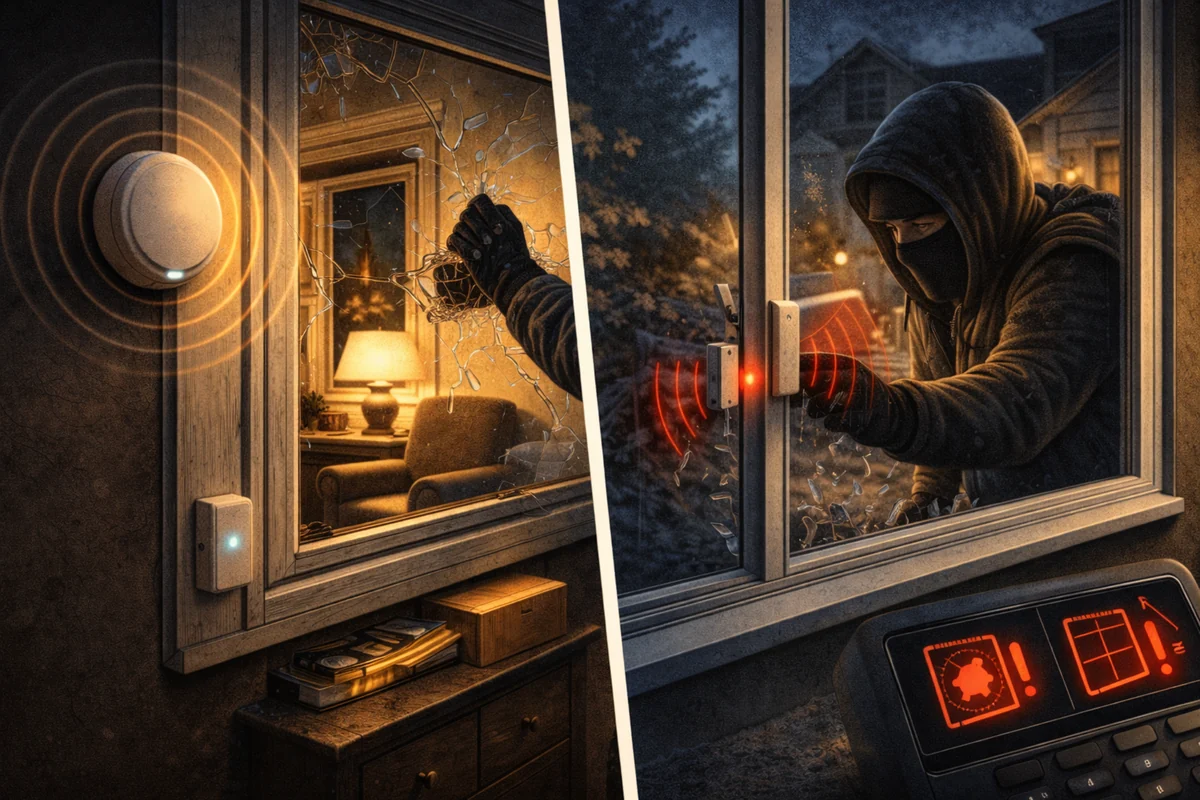
Window security sensors, often called contact sensors, trigger when a window or door physically opens. They rely on two small components that separate when the window moves. Glass break sensors, on the other hand, don’t care if the window opens. They listen. Specifically, they’re tuned to detect the unique sound frequency pattern of breaking glass.
| Sensor Type | What It Detects | Trigger Condition |
| Window sensor | Opening/closing | Window is physically opened |
| Glass break sensor | Sound of glass shattering | Glass is broken/smashed |
That difference might seem small, but it completely changes how each one protects your home, especially when assessing your home like a burglar would for vulnerabilities.
🔊 How Glass Break Sensors Work
Glass break sensors are a bit more sophisticated than they look. They don’t just react to any loud noise. They’re designed to recognize a very specific sound pattern involving both impact and shattering. Most modern security systems use acoustic sensors that filter out everyday household noises.
Expert Tip: Most models listen for a low-frequency “thud” followed by a high-frequency “shatter.” This dual-check system prevents your dog barking or a dropped plate from triggering a false alarm.
Understanding how glass break sensors work is essential for proper placement. Because they “listen,” they don’t need to be mounted on the window itself. A single unit placed on a wall or ceiling can often cover multiple windows within a 20-foot radius.
However, you must ensure there isn’t a clear listening path obstruction, like heavy blackout curtains, that could muffle the sound.
🚪 How Window Security Sensors Work
Window sensors are about as straightforward as it gets. They are small, reliable, and widely used for a reason. Each sensor has two parts: one attached to the window frame, the other to the moving sash. When those two pieces separate, the circuit is broken, and the system registers an event.
Why they are a DIY favorite:
- Immediate alerts the second a window is opened.
- Highly reliable with minimal false alarms.
- Can be used on doors, cabinets, and even securing sliding glass doors.
- Extremely easy to install without professional help.
But they do have a limitation. If someone breaks the glass and reaches in without sliding the window up, the sensor won’t trigger. This is a common gap in what DIY home security actually protects against.
⚖️ Glass Break Sensor vs Window Sensor: The Real Difference
The difference between glass break and contact sensor isn’t about choosing a winner. It’s about understanding coverage gaps. A window sensor protects against entry by opening. A glass break sensor protects against forced entry through smashing.
- Read More: Review our window alarm system comparison to see how different hardware stacks up.
| Scenario | Window Sensor | Glass Break Sensor |
| Window opened normally | ✔️ | ❌ |
| Glass shattered | ❌ | ✔️ |
| Glass broken, no opening | ❌ | ✔️ |
| Frame forced open | ✔️ | ❌ |
Looking at it this way, it becomes pretty clear why relying on just one type can leave blind spots in your defense.
🧠 Do You Need Both Glass Break and Window Sensors?
Short answer? In many cases, yes. If you’re aiming for a layered home security framework, using both types fills in each other’s gaps. This is especially true for ground-floor windows and home security threats most people ignore, like a burglar simply smashing through a large pane of glass.
Situations where both are worth it:
- Large windows or glass doors: More surface area means more “smash” potential.
- Secluded entry points: Side windows or back doors that aren’t visible to neighbors.
- Basement windows: Often the most common security mistakes include leaving these overlooked.
If you’re asking “do you need both glass break and window sensors,” the answer depends on your risk tolerance. But for most ground-floor setups, combining them is the smarter move.
🏡 Best Sensors for Window Security by Situation
The best sensors for windows security depend on your layout. It’s not about installing everything everywhere; it’s about putting the right sensor in the right place.
| Home Scenario | Recommended Setup |
| Small Apartment | Window sensors on all entry points |
| Ground-Floor Home | Window + glass break sensors in main areas |
| Large Home | Combination with multiple glass break zones |
| Sliding Glass Doors | Both sensor types for full coverage |
- Read More: For those on a budget, check out how to design a home security system on a budget using this specific logic.
⚠️ Common Mistakes People Make
A lot of people install sensors and assume they’re fully covered. This is one of the most common DIY home security failures.
Expert Tip: Never place a glass break sensor more than 20 feet away from the window it is meant to protect. Also, ensure there is no thick furniture or sound-absorbing material (like acoustic panels) in between.
Avoid these pitfalls:
- Relying only on window sensors for floor-to-ceiling glass.
- Placing glass break sensors too far from windows.
- Ignoring the importance of securing your garage windows.
- Forgetting to test your system regularly to ensure the batteries are still alive.
🔄 Layering Sensors for Real Protection
Security works best when it’s layered. This is how you build redundancy into a DIY security setup. By using both sensor types, you create overlapping coverage. If one method is bypassed, the other still has a chance to catch the intruder.
The layered logic:
- Window sensors: Protect against physical movement and prying.
- Glass break sensors: Protect against brute force and shattering.
- External layers: Use outdoor motion lighting to deter them before they even touch the glass.
🧩 Final Thoughts
When you compare a glass break sensor vs window sensor, it’s tempting to treat it as an either-or decision. In reality, they solve different problems. Window security sensors are reliable, simple, and essential foundation pieces. But glass break sensors add that missing layer that catches what contact sensors can’t.
Building a secure home is an iterative process. You can always upgrade your DIY system over time as your budget or needs change. Just remember: security doesn’t have to be complicated, but it does need to be intentional.