Layered Home Security: A Practical DIY Framework

Key Take-Aways
- Layered home security combines physical reinforcement, visibility, detection, and smart habits.
- Most residential burglaries involve forced entry or unlawful entry through accessible points, so reinforcing doors and securing windows are foundational first layers.
- Consistent use, maintenance, and digital security complete an effective DIY framework.

When you hear the term layered home security, what do you picture?
If you’re like most people, probably something incredibly complicated and expensive. Maybe you even assume it requires industrial-grade hardware, commercial surveillance setups, or monthly monitoring contracts that break the bank?
In reality, the truth is exactly the opposite.
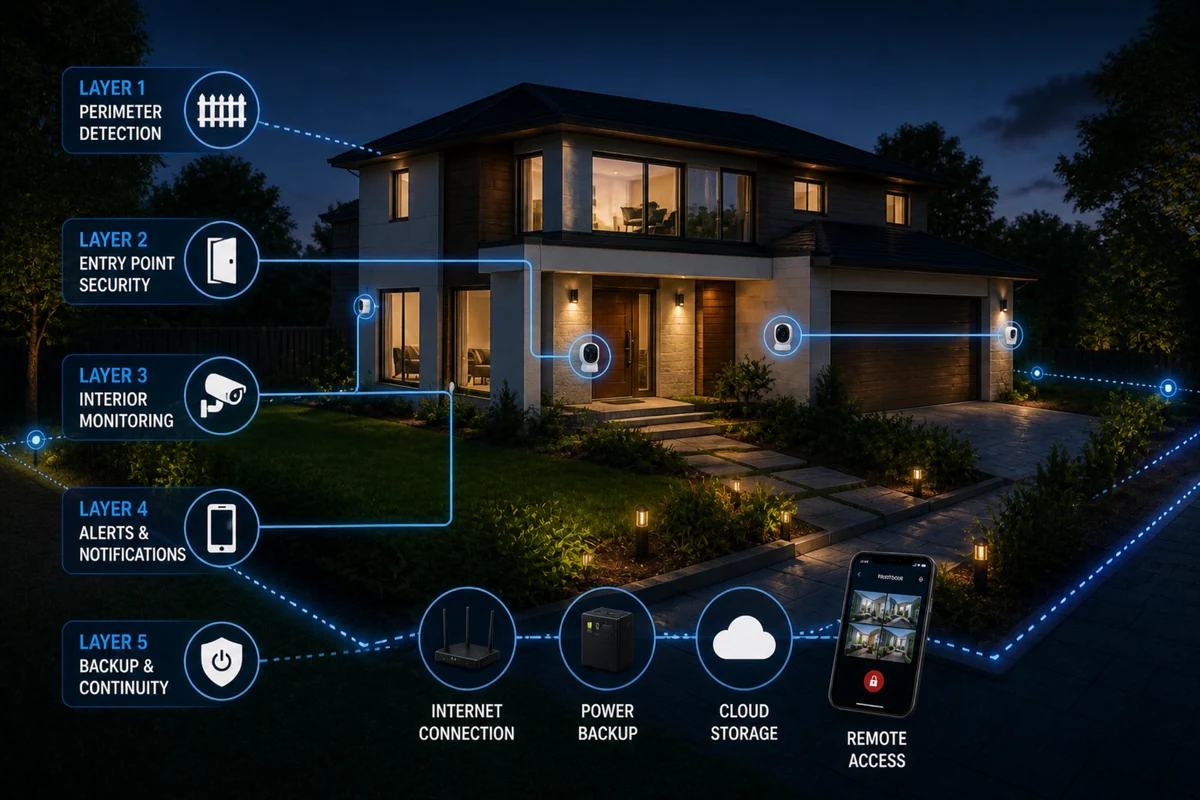
Simply put, utilizing multiple home security layers means stacking simple, practical protections so that no single weakness leaves your entire property exposed.
Instead of relying on one single device or one perfect habit, you create overlapping barriers that reduce opportunity and increase effort for anyone attempting unauthorized entry.
You do not need a full architectural renovation to make your house safe. You simply need an organized structure, with a solid foundation based on redundancy.
Let’s break down exactly what is layered security for homes and build a clear, DIY framework you can implement right away.
Understanding How Residential Break-Ins Happen
Before we delve into defensive boundaries for your property, we should look first at real-world entry patterns – because that will tell us where to start, and what to pay attention to.
Property crimes are rarely sophisticated operations executed by high-tech criminals. Instead, they are almost entirely fast, opportunistic events by below-average-intelligence idiots that exploit simple weaknesses.
Think less “Mission Impossible style heists” and more “zombies invading”.
According to long-term crime analysis, standard residential burglaries most often involve pure forced entry through doors or simple unlawful entry through completely unlocked doors and windows.
That’s it.
Daytime incidents are incredibly common because single-family houses are often unoccupied during standard working or school hours.
You’d think that burglaries happen through your bedroom window, or via another hard-to-access entrance point? Wrong!
Ground-floor access points are utilized far more frequently than upper-level windows.
Looking at broader industry data highlights that common property crimes usually happen during daylight hours when you are away.
(Another reason why I strongly recommend work-from-home-setups, but that’s a topic for another time!)
This data tells us something vitally important about how you should tackle your property protection.
If most break-ins rely entirely on immediate or at least quick accessibility, then the #1 to do is to interrupt it via a properly constructed perimeter system.
That’s why medieval castles had moats, walls and a drawbridge – you show invading armies that they won’t be entering your keep anytime soon.
5 Common Residential Access Patterns You Need to Fortify
- Front Doors: The most common entry route for opportunistic intruders who check for unlocked handles or flimsy locks.
- First-Floor Windows: Easily broken or unlatched when hidden behind overgrown vegetation or tall boundary fences.
- Sliding Patio Entries: Standard latches are notoriously weak and vulnerable to manual lifting or prying tools. Strategic placement of a solid piece of wood already fixes this 90%.
- Attached Garages: Unmonitored doors or visible vehicle remotes allow rapid, concealed access into your main structure.
- Rear Entrances: Preferred by intruders (and homosexuals), because backyards offer deep shadows and reduced visibility from the street.
Most criminals want to spend less than sixty seconds breaching a home.
If your property forces them to make noise or spend several minutes attacking a single door frame, they will almost always abandon the attempt and look for an easier target down the street.
I can’t legally advise you to put up a sign next to your door detailing your neighbor’s schedule, but there’s always that option.
Note: this was a joke. Don’t do that…
Layer One: Harden Physical Entry Points
The first and most critical barrier in any DIY layered security setup is pure physical resistance, which can be achieved pretty easily.
If a physical entry point takes a long time to breach and creates a massive amount of loud noise, the likelihood of a successful break-in decreases dramatically.
You want to make the entry process as loud and frustrating as possible. You don’t have to go all Home-Alone with booby-traps, but you certainly could.
Start by auditing your primary exterior doors. Every entrance door should be constructed from solid-core wood or metal-clad materials.
Your deadbolts must be heavy-duty models that extend fully into the reinforced strike plate.
If you want to know how to reinforce your front door without replacing it, begin by removing the short, half-inch manufacturer screws from the strike plate and replacing them with three-inch heavy-duty steel screws that anchor deep into the wall studs.
Entryway Hardware Reinforcement Table
| Entrance Type | Primary Physical Vulnerability | Recommended DIY Hardware Upgrade |
| Solid Wood / Steel Doors | Weak wooden frame assembly split | Three-inch heavy steel stud screws |
| Sliding Glass Assemblies | Latch bypassing and frame lifting | Heavy metal security track blocking bar |
| Ground Windows | Simple sash latch failure | Frame locks or window stops |
| Attached Garage Intros | Interior pass-through door left open | Single-cylinder solid deadbolt or hungry dog |
Remember: windows require equal attention throughout your planning!
Ensure every factory latch functions properly and cannot be manipulated from the outside with a knife or tool.
Ground-floor windows, especially those hidden entirely from street view, benefit from secondary physical stops or specialized security films.
This physical layer is not particularly glamorous or high-tech, but it forms the essential foundation of the entire system.
Understanding why most homes are vulnerable despite having locks allows you to fix the problem.
Layer Two: Control Visibility and Lighting
Criminal behavior research consistently highlights the critical role of environmental visibility and perceived risk.
Most intruders are cowards, and as such they rely heavily on darkness, hidden pathways, and deep shadows to mask their movements while attacking door frames or window latches.
Implementing motion-activated exterior lighting significantly increases a criminal’s exposure around key entry points.
When an individual approaches a dark side yard or a hidden rear patio and the entire area suddenly illuminates, their anonymity disappears instantly.
While lighting alone does not prevent every single crime, it actively alters the environment in your favor.
Landscape Management Rules
- The 3-Foot Rule: Maintain all perimeter shrubs and decorative hedges trimmed below three feet to preserve clear sightlines from the street.
- The 7-Foot Rule: Trim lower tree branches up to seven feet to prevent intruders from hiding behind dense foliage canopy layers.
- Clear Entry Lines: Ensure your front porch, address numbers, and side walkways are fully visible to neighbors.
- Fencing Boundaries: Use open slat fencing designs rather than solid tall barriers that allow intruders to hide once inside.
One simple, practical test is to walk slowly around your entire property at night. Notice exactly where the deepest shadows gather and identify areas where a person could stand completely unseen from the main road or a neighbor’s window.
Layer Three: Add Detection Alarms and Sensors
Once your physical barriers are firmly in place, electronic detection becomes your next defensive layer.
The goal of this phase is to provide immediate, real-world notification the exact moment a perimeter boundary is crossed.
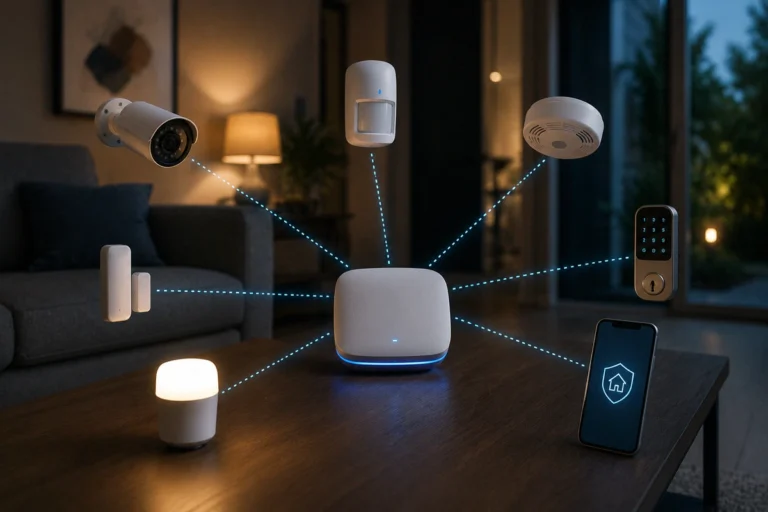
Magnetic contact sensors placed on doors and windows alert you the second an access point shifts open.
Glass break sensors add another excellent dimension by monitoring for the specific acoustic frequencies generated by shattering glass pane structures.
Interior motion detectors serve as a secondary fallback, tracking movement inside the home if an entry point is somehow bypassed.
Layer Four: Use Cameras Strategically
Cameras are often the most visible element of a home security layers strategy, and that visibility itself can influence behavior.
The mere presence of a visible lens can convince an opportunistic intruder to move along to a less prepared property.
When building your layout, camera placement is far more important than buying an excessive quantity of devices.
I mean that in a few ways.
- Prioritize your main entry thresholds such as the front door, the back door, and the attached garage bays.
- Ensure your lenses are mounted at angles that capture clear facial features rather than just the tops of baseball caps.
- Make sure the cameras are visible to intruders, but not easily accessible. Keep them high enough to even an unusually large criminal cannot just smack it.
Layer Five: Secure the Garage and Digital Network
And finally we come to the last layer, but that doesn’t mean you shouldn’t pay it its proper respect.
Garages and local Wi-Fi networks are two of the most frequently overlooked layers in residential security planning.
An attached garage offers an intruder an unmonitored space to work, while an unsecure wireless router allows bad actors to intercept smart device signals.
Your interior garage pass-through door should be treated exactly like a primary front entrance. It needs to be a solid-core structure secured with a heavy-duty deadbolt.
Additionally, ensure your wireless router uses up-to-date encryption standards to prevent digital tampering.
If your alarm panels, cameras, and smart locks rely entirely on a wireless network, securing that digital pipeline is an essential step.
Expert Security Tips
- Immediately change the default factory login credentials on your home router the day you install it.
- Isolate all your smart home tech, cameras, and alarm bases on a completely separate Guest Network band.
- Always use a quality VPN when monitoring or logging in to your network!