💎Best Places to Hide Valuables (And Where Thieves Actually Look)

TLDR
- Most burglars search predictable places first like bedrooms, drawers, and closets.
- Hiding valuables in “obvious” spots (under mattresses, in jewelry boxes) is ineffective.
- The best hiding places are unexpected, low-interest areas that require effort to access.
- Time and difficulty are your biggest advantages during a break-in.
- A properly installed safe is still the most reliable option for high-value items.
If you’ve ever tried to hide valuables at home by tucking jewelry under a mattress or cash in a drawer, you are not alone. Almost everyone has tried to outsmart a potential thief at some point. The problem is, most hiding spots aren’t nearly as clever as they feel. They’re familiar. And that’s exactly why they fail.
Burglars don’t wander around your home randomly. They move fast, often spending only a few minutes inside, and they go straight to the places people tend to use.
Once you understand that pattern, it becomes much easier to choose best places to hide valuables that actually work. This is a foundational part of any DIY home security strategy.
🕵️♂️ Where Thieves Actually Look First
Let’s start with the uncomfortable truth. The majority of common hiding places are already known. According to security experts, the bedroom is usually the first stop because that is where valuables tend to be stored.
Common “Red Zone” Locations:
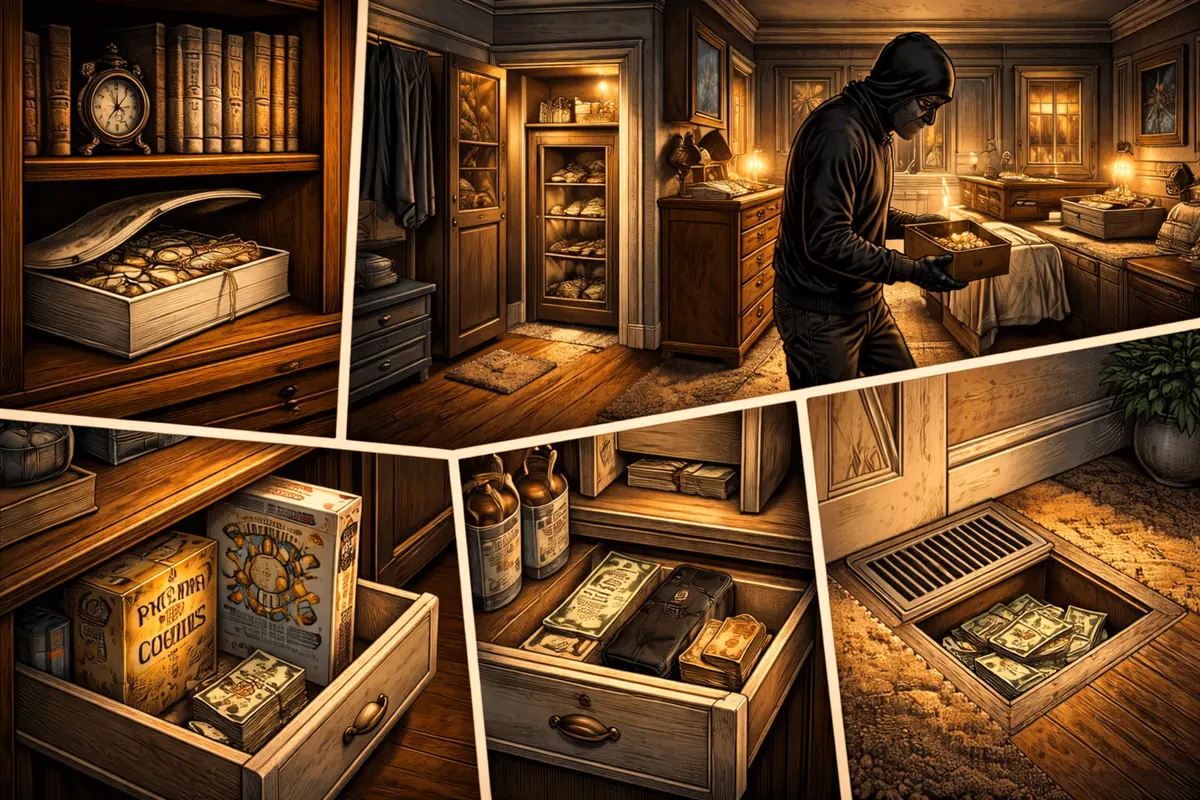
- The Master Bedroom: Drawers, closets, and nightstands are checked first for cash and jewelry.
- Under the Mattress: This remains one of the most predictable spots on a thief’s mental checklist.
- Jewelry Boxes: Tucked away or not, the container itself signals the prize inside.
- Bathroom Cabinets: A frequent stop for prescription medications and small hidden items.
If a hiding spot is easy to reach and commonly used, it is likely already compromised. This is a primary reason why many homes remain vulnerable even with basic precautions.
⏱️ Why Time Matters More Than Creativity
One thing that often gets overlooked is how quickly most break-ins happen. Burglars aren’t trying to find everything; they’re trying to find enough, fast. They prioritize speed over thoroughness.
| Factor | Burglar’s Perspective | Homeowner’s Strategy |
| Search Time | Usually under 8 to 10 minutes | Maximize the time required to find items |
| Effort | Low (easy-to-reach spots) | Use heavy or inaccessible locations |
| Noise | High risk (avoiding mess) | Use spots that require loud disassembly |
Instead of asking, “Where should I hide this?” a better question is, “Where would someone skip because it takes too much effort?” That shift in thinking is essential for DIY home security planning.
🚫 The Worst Places to Hide Valuables
Before we get into better options, it’s worth being clear about what to avoid. Anything in plain sight or in a standard storage location is a bad choice. This includes drawers, closets, and bedside tables.
Expert Tip: Avoid using “fake” hiding items that look out of place. A hollow book works only if you have a full bookshelf. An unusual container sitting alone on a shelf defeats the purpose and highlights exactly where burglars look for valuables.
Portable containers are also risky. If something can be picked up and taken quickly, it doesn’t matter how well it’s hidden. This is one of the most common security mistakes homeowners make.
✨ What Makes a Good Hiding Spot
Effective safe hiding spots in house share a few key traits. They are not obvious, they are not located in high-traffic search areas, and they require extra effort to access.
- Read More: For a full analysis, see how burglars choose their entry patterns to understand what areas they ignore.
The goal isn’t to create something that looks hidden; it’s to make something that doesn’t look important at all. Good spots blend in with their surroundings and don’t rely on luck. They are an extension of a properly layered security framework.
🏠 Better Places to Hide Valuables
Now let’s look at what actually works when you need to hide money and jewelry at home. Areas that burglars tend to overlook are often the least convenient ones, such as entryways or utility spaces.
High-Effort Hiding Ideas:
- Inside Heavy Furniture: Attached discreetly to areas that require effort to reach or tilt.
- Everyday Objects: Using mundane, boring items that look completely normal and staged within their environment.
- Boring Spaces: Laundry rooms or utility closets often get skipped because they feel too mundane to bother with.
Integrating these into your minimalist security setup can be highly effective. The key is subtlety—it should look completely normal, not staged.
📂 Using Multiple Hiding Spots
One strategy that doesn’t get enough attention is splitting your valuables. Instead of keeping everything in one place, divide items across several locations.
- Read More: This is a form of building redundancy into your DIY security to ensure one mistake doesn’t result in a total loss.
This approach reduces the risk of losing everything in a single incident. Even if one spot is found, the others are likely to remain untouched due to the time constraints burglars operate under.
🔐 When a Safe Makes More Sense
For higher-value items, hiding alone isn’t always enough. A properly installed safe provides a level of security that even the best home safe hiding ideas can’t match.
| Safe Type | Best Placement | Security Note |
| Wall Safe | Behind a heavy object | Must be professionally anchored |
| Floor Safe | Under a rug or furniture | Hardest to discover and remove |
| Concealed Safe | In a secondary utility room | Avoid master bedroom placement |
Placement matters; a safe in an obvious location may still work, but a concealed placement adds another layer of difficulty. If you are storing important documents or large amounts of cash, a safe is usually the better choice than simple secret compartments for valuables.
🖼️ Don’t Forget About Visibility
Hiding valuables inside your home is only part of the equation. If expensive items are visible from outside, they can make your home a target in the first place.
Expert Tip: Use smart lighting to simulate occupancy and ensure that your most expensive electronics are not visible through street-level windows.
As noted in various surveillance studies, thieves follow the path of least resistance. Reducing visibility helps prevent the situation altogether. It’s a simple step, but it plays a bigger role than most people expect. This is a common tactic for renters with DIY security setups who cannot make permanent changes.
⚖️ Balancing Security and Accessibility
There is always a trade-off between security and convenience. If something is too difficult to access, you’re less likely to use that hiding spot consistently. On the other hand, if it’s too easy, it’s probably not secure enough.
Finding the “Sweet Spot”:
- Choose a spot that takes less than 2 minutes for you to access.
- Ensure it would take a stranger more than 5 minutes to find.
- Use it every time, not just when you leave for vacation.
Knowing what DIY home security actually protects against helps you set realistic expectations for these spots.
🏁 Conclusion: A Quick Reality Check
The idea of a “perfect hiding spot” is a bit of a myth. What actually works is unpredictability and effort. Burglars look for easy wins; the more your setup removes those easy wins, the better your valuables are protected.
Think of hiding as one part of a broader strategy, not the entire solution. Once you combine these habits with regular security testing, your home becomes a much harder target.