🛡️ What DIY Home Security Actually Protects Against

TLDR
- DIY setups excel at flashing early warning signs, dropping risk metrics, and stripping away a property’s overall vulnerability.
- Magnetic sensors and interior movement grids provide near-instant verification when someone physically manipulates an entry path.
- Advanced components protect your structural property against non-human hazards like hidden plumbing breaks and sudden fires.
- Standalone equipment lacks the physical capacity to stop a motivated intruder from executing a forced breach.
- Maximizing your safety requires layering distinct pieces together rather than betting everything on a single sensor tier.
There is a highly pervasive assumption floating around the residential landscape that unboxing a consumer security system automatically makes your property perfectly safe.
It is easy to see why people fall into this trap, but treating a tech product like an impenetrable, invisible shield is an operational misstep.
Modern self-installed systems do not lock down a house like a military fortress; instead, they excel at highlighting risk, boosting situational awareness, and ruining a building’s overall appeal to opportunists.
Gaining a grounded perspective on what your equipment handles allows you to construct a rational, real-world defensive blueprint without relying on false expectations.
Let’s dive into exactly what these affordable wireless setups can do for your perimeter.
🚪 Real Protection Against Break-Ins
The absolute core of any residential hardware rollout is tracking and managing unexpected property access.
When establishing your baseline protection, understanding what home security protects against helps you place your components where they have the biggest tactical impact.
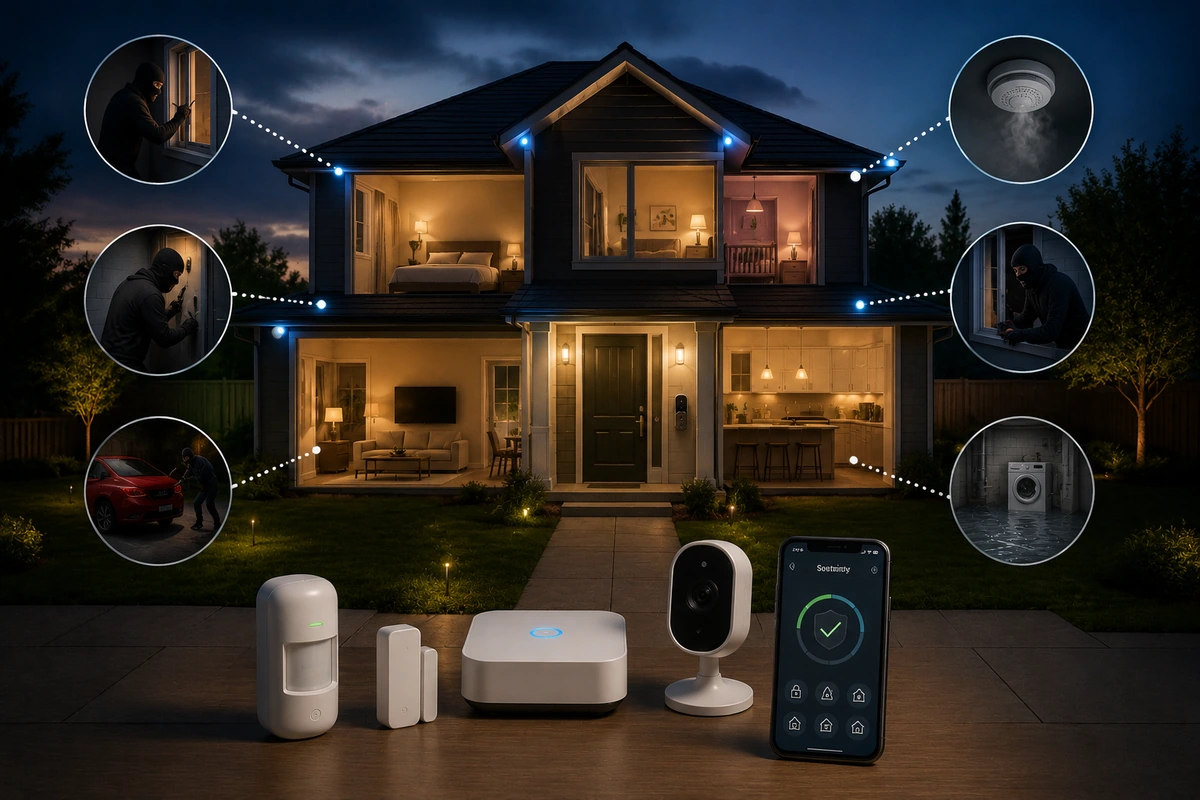
Magnetic entry contacts immediately note when a window frame separates, while interior infrared motion eyes watch open communal spaces.
These components work in tandem to eliminate the element of surprise, ensuring you know the exact moment a boundary is crossed.
However, the real power of these networks lies in psychological deterrence rather than physical confrontation.
Most property crimes are crimes of opportunity, and individuals looking for quick targets actively scan for visible signs of operational gear.
If your property features clear deterrent signs, prominent decals, and visible lenses, the threat profile changes completely.
Opportunists will almost always bypass a monitored boundary in favor of an easier house down the street that lacks basic defenses.
Read More
If you want to understand the typical blind spots that property owners leave open for opportunists, take a close look at our breakdown of what makes a home easy to break into.
🚶 Managing Unauthorized Entry and Daily Access
Not every single security incident on your property is going to be a dramatic, late-night forced entry.
Often, the real threat is far more mundane, such as an oversight like leaving a side door completely unlatched after bringing in groceries.
It could also be an unannounced maintenance contractor walking in on the wrong day or a guest abusing their access privileges.
Self-installed equipment mitigates these awkward scenarios by giving you complete operational visibility into daily foot traffic.
Instead of guessing whether your home is secure while you are sitting at your desk, your mobile app provides real-time state logs for every entry point.
If a door swings open at an unusual hour, you receive an immediate alert, allowing you to instantly assess the situation via a live video stream.
This level of constant awareness completely transforms how you manage your property, replacing lingering anxiety with actual, observable data.
Essential Entry Components
- Contact Sensors: These devices track the open or closed states of entry frames and belong on front doors, patio sliders, and ground-level windows.
- Motion Detectors: These units scan interior volume for body heat changes and work best in main hallways, master bedrooms, and living rooms.
- Glass Break Ears: These sensors listen specifically for the distinct frequency of shattering panes around large window walls and sliding back doors.
📦 Defending Against Porch Pirates and Front Door Scams
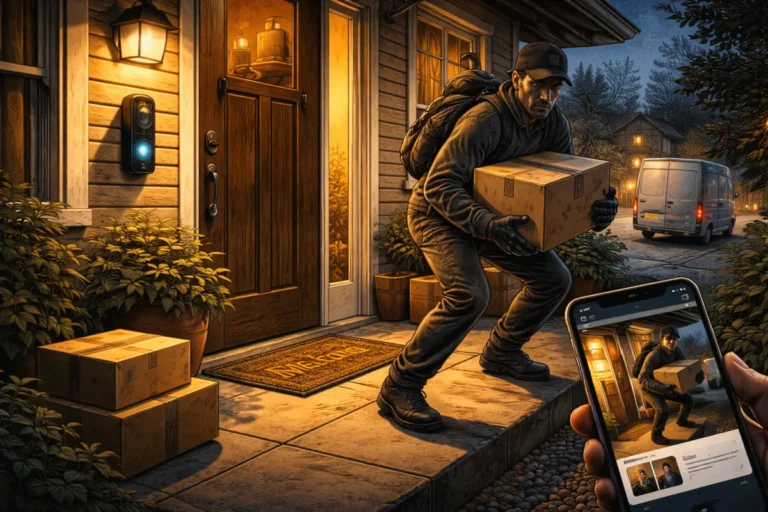
Package theft has become an incredibly common headache for modern neighborhoods, turning front porches into prime targets for drive-by opportunists.
This specific vulnerability is exactly where smart video doorbells, high-definition external lenses, and connected deadbolts prove their worth.
These tools allow you to actively track incoming deliveries, get instant pings when a courier enters your walkway, and check your doorstep from anywhere.
When analyzing what home security protects against, it helps to be honest about what cameras can and cannot prevent on their own.
A digital lens lacks the physical capability to reach out and stop an opportunistic thief from grabbing a box off your step.
However, visible surveillance tools radically alter the risk equation for anyone stepping onto your porch.
The presence of a prominent lens introduces accountability, forcing opportunists to move along rather than risk their faces being recorded in high definition.
Read More
To explore a complete strategy for securing your doorstep and keeping your deliveries safe from opportunists, check out our guide on how to prevent package theft.
📱 Seamless Monitoring While You Are Away
One of the most immediate benefits of setting up a modern wireless network is the ability to maintain a continuous connection to your property.
Whether you are traveling for business, working an evening shift, or managing multiple properties from afar, your system keeps you in the loop.
This constant connectivity means you never have to wonder about the state of your house while you are gone.
You can quickly review recent event logs, verify that your entry points are completely sealed, and check in on your pets using a mobile app.
This capability is a massive asset for anyone managing an active, mobile lifestyle.
If you travel frequently, for example if you are a digital nomad, having comprehensive home security coverage allows you to monitor your main residence from anywhere in the world.
This constant access completely eliminates that frustrating, ambient anxiety about whether you forgot to secure the back window before rushing out to catch a flight.
Expert Security Tip
Automate Your Away Routines: Do not rely on your memory to arm your perimeter every time you walk out the door. Use your system’s geolocation settings to create an automatic geofence that reminds you to arm the system the second your phone moves a set distance away from your property.
🔥 Catching Hidden Environmental Hazards
A lot of property owners tend to overlook the fact that modern residential security ecosystems handle far more than just human threats.
The scope of comprehensive home security coverage extends directly into environmental protection, tracking invisible dangers that can cause massive structural damage.
By integrating smart smoke alarms, carbon monoxide ears, and water moisture contacts into your central gateway, you create a comprehensive safety mesh.
These environmental tools utilize the exact same communication paths as your standard entry window contacts.
If a utility pipe springs a hidden leak behind your washing machine, or a faulty appliance begins to smoke, your system broadcasts an alert instantly.
This rapid notification layer is arguably just as vital to your home’s survival as standard intrusion tracking.
An unmonitored plumbing break or a smoldering electrical fire can easily cause far more financial devastation to your property than a standard break-in.
Read More
If you want to see how easy it is to add these life-saving environmental detectors to your existing wireless gateway, browse our breakdown on why you should add smoke, CO, and water sensors to your system.
🛑 Realistically Understanding the Limits of Your System
To get the most out of your hardware investment, you have to be completely honest about the inherent limits of home security systems.
A common misconception is that installing a consumer alarm setup means your home is physically fortified against all forms of entry.
The reality is that consumer alarms focus entirely on detection, communication, and psychological deterrence rather than physical containment.
When evaluating what security systems actually prevent, it is vital to remember that these setups do not physically stop burglars from executing a forced entry.
If a highly aggressive, determined intruder is completely comfortable ignoring a screaming 110-decibel siren and does not care about being recorded, a wireless sensor cannot physically bar them from breaking a window pane.
Your electronic hardware is designed to strip away the intruder’s anonymity, destroy their timeline, and instantly alert you to the breach.
Recognizing this distinction allows you to see your electronics as an early warning network rather than a replacement for strong physical deadbolts and reinforced frames.
Read More
To discover how to properly evaluate your property’s physical weak points through the eyes of an intruder, take a look at our guide on assessing your home like a burglar would.
⚡ Shifting the Timeline with Faster Response Times
The defining structural advantage of an optimized DIY security layout is its sheer operational speed.
When an entry contact is separated or an interior motion eye is tripped, the wireless signal hits your central hub instantly.
Within seconds, a push notification is delivered directly to your smartphone, giving you immediate situational awareness.
This rapid communication loop allows you to take control of the situation before a minor incident escalates into a catastrophic loss.
You can instantly view your live video feeds to see what triggered the alarm, coordinate with neighbors, or dispatch local emergency services.
Without a responsive electronic system watching your property, a break-in or an environmental leak could easily go unnoticed for days.
That massive delay is often the difference between catching an issue early and coming home to an absolute disaster.
Understanding the Timeline
In a traditional property without an alarm, an intruder enters, enjoys hours of undetected access, and you only discover the loss much later. With a monitored DIY alarm, the sensor trips within two seconds, the siren blasts while your phone alerts you, and the intruder almost always flees immediately.
🛠️ Catching and Reducing Everyday Operational Risks
Not every single notification from your security app is going to represent a high-stakes emergency or a forced entry.
In day-to-day life, your system spends the vast majority of its time catching simple, human mistakes before they cause issues.
It helps you spot the everyday oversights that naturally happen when your family is rushing out the door in the morning.
For instance, your system will alert you if a ground-floor window was left unlatched, or if a side garage door didn’t close all the way.
By reviewing your system’s open-status logs before you head to bed, you can catch these minor oversights and secure your property before turning in.
It is a quiet, subtle form of home protection, but over time, fixing these daily vulnerabilities prevents your home from becoming an attractive target.
Read More
If you want to establish a clean, simple routine to ensure your property is completely secured every single night, check out our blueprint for a simple nighttime home security routine.
🛑 What DIY Security Arrays Cannot Handle
Just as you need to know what your system covers, you must also recognize what threats alarms deter and where electronic systems hit a wall.
Wireless security hardware is not a magic fix that replaces traditional physical security measures like high-quality locks and solid door frames.
Furthermore, a self-installed system does not automatically guarantee that local police forces will immediately rush to your property.
Unless you pair your equipment with a dedicated professional monitoring contract, the responsibility to review alerts and call emergency dispatch falls entirely on your shoulders.
Additionally, no electronic setup can completely erase the inherent risks of property ownership.
The true objective of home security is to systematically minimize your overall risk profile and give you back control, rather than trying to engineer a completely impossible scenario of absolute perfection.
Read More
To gain a clearer understanding of what your electronic sensors can and cannot handle on their own, browse our analysis of what diy home security cannot protect against.
🧱 The Immense Power of a Layered Security System
If there is one absolute truth in residential defense, it is that relying on a single piece of security hardware leaves you incredibly vulnerable.
The most dependable configurations rely on a layered architecture, where multiple defensive elements work together to form a comprehensive shield.
By spreading your defensive tools across different zones of your property, you ensure that if an intruder manages to bypass one layer, the next tier is waiting to catch them.
A balanced, multi-layered DIY layout typically functions in a clear, logical sequence:
- The Perimeter Layer: Clear yard signage and strategic outdoor motion lighting discourage opportunists before they ever approach your home.
- The Boundary Layer: Magnetic contact sensors watch your doors and windows, triggering an immediate alarm if an entry point is forced.
- The Verification Layer: High-definition indoor and outdoor cameras allow you to instantly check live feeds and confirm exactly what triggered a sensor alert.
- The Internal Fail-Safe: Interior motion detectors scan your main hallways, acting as a final backup loop if an intruder avoids a window contact.
Read More
To discover how to easily combine your sensors, cameras, and physical locks into a seamless, interconnected layout, explore our layered home security practical framework.
📐 Building a System That Fits Your Specific Lifestyle
Every residential property features a unique layout, meaning a security configuration that works perfectly for a suburban home might be completely impractical for a downtown rental.
Tailoring your hardware choices to your actual architecture ensures you don’t overspend on unnecessary components.
A compact apartment layout usually focuses its entire hardware budget on a few high-value components, like securing the primary front door and setting up indoor cameras.
In contrast, a sprawling multi-story suburban home requires a much larger hardware mesh to properly cover multiple ground-floor entryways, side windows, and detached garage structures.
Your daily household routine should also dictate how you configure your protective gear.
Families with kids will want to focus heavily on chime alerts that track door states during the day, while frequent travelers will benefit from deploying an expanded camera grid.
The goal is to design a balanced, logical setup that addresses the actual, real-world risks of your property, rather than building an overly complex system tailored to an imagined worst-case scenario.
Read More
If you are currently setting up a security loop in a smaller space and want to maximize your coverage without buying bulky equipment bundles, take a look at our guide on the best diy security setups for apartments.
🚪 Conclusion
Unboxing a DIY home security system does not create an impenetrable, flawless shield around your property, but it remains an incredibly powerful tool for reducing your everyday risks.
Your system works by deterring opportunists, detecting boundary breaches instantly, and giving you the actionable data you need to respond quickly.
From tracking forced entry paths and minimizing package theft to monitoring hidden environmental hazards, a well-planned hardware setup provides immense real-world value.
The secret to maximizing your investment is pairing your wireless hardware with solid physical door locks, maintaining realistic expectations, and building your system in layers over time.
By focusing your budget on the core essentials and choosing an expandable system, you can easily build a responsive, reliable shield that keeps your property secure without draining your savings account.