🐕🦺How to Set Up Motion Sensors If You Have Pets

TLDR
- Pet friendly motion sensors rely on proper placement and settings, not just the pet immune label.
- Mount sensors higher and angle them away from areas where pets climb or jump.
- Avoid pointing sensors at stairs, furniture, or heat sources that can trigger false alarms.
- Use sensitivity settings and pet specific modes to filter out smaller movements.
- Testing your setup with your pet moving around is essential before relying on it.
Motion sensors are one of the most useful parts of a home security system. They cover large areas, detect movement quickly, and add an extra layer beyond doors and windows. But if you have got pets, things get a bit more complicated. A sensor that works perfectly in a pet free home can turn into a false alarm machine once a dog starts pacing or a cat decides the couch is a launchpad.
The good news is you do not have to give up motion detection. You just need to learn how to set up motion detectors with pets in a way that respects their behavior while maintaining your home’s safety. This balance is a core part of DIY home security systems explained for modern homeowners. Let us walk through how to do that without turning your home into a guessing game.
🧠 How Pet Friendly Motion Sensors Actually Work
Not all motion sensors are the same, but most DIY systems use passive infrared (PIR) sensors. These do not “see” images; instead, they detect changes in heat (infrared energy) and movement across zones within the sensor field of view.
According to SafeWise expert analysis, pet friendly motion sensors do not ignore animals completely. Instead, they are designed to filter out motion below a certain size, weight, or heat signature. This means two things:
- Placement matters just as much as the sensor itself.
- Pets can still trigger alarms if the setup is not right.
This is where most people run into trouble. They rely on the label but skip the setup details. When you are designing a home security system on a budget, understanding the mechanics of your hardware saves you from expensive technical support later.
📍 Placement Is Everything (Seriously)
If there is one thing to get right, it is this. A well-placed sensor can ignore a moving pet all day. A poorly placed one will trigger constantly, which is one of the common DIY home security failures that leads people to disable their systems entirely.
Do this:
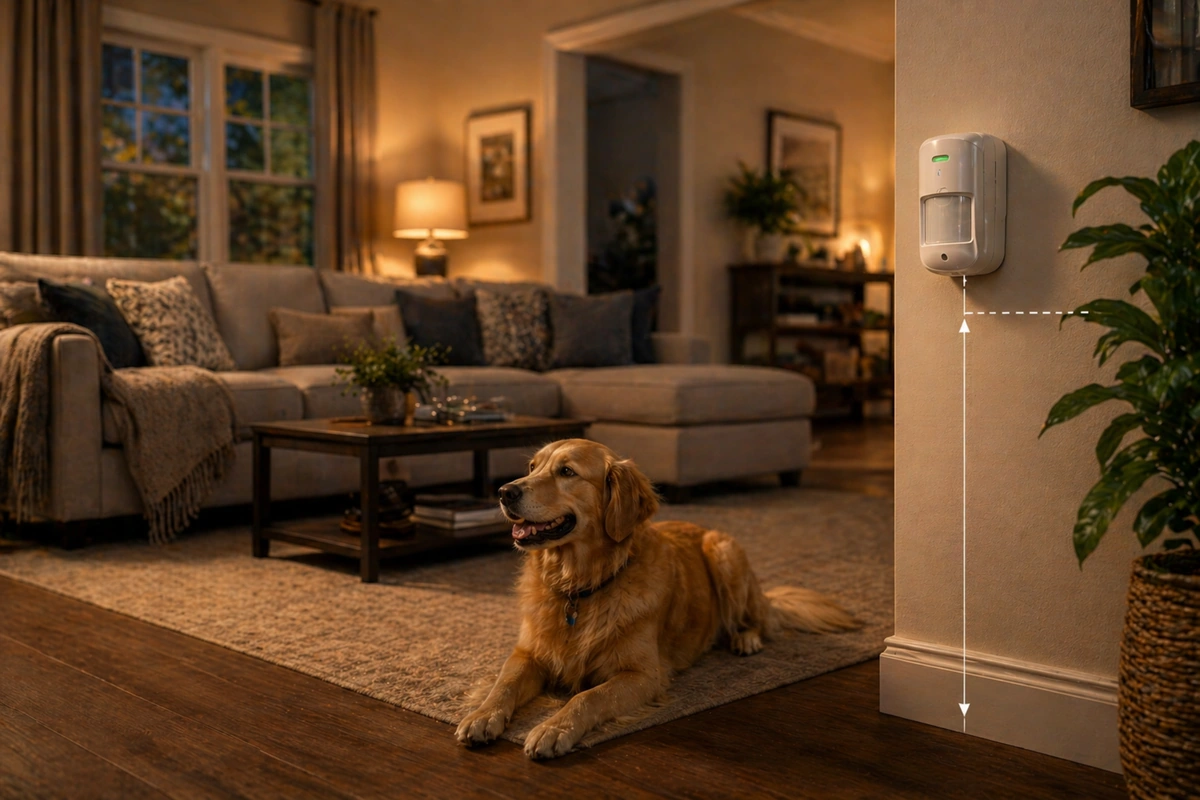
- Mount sensors around 6 to 8 feet (1.8 to 2.4 meters) high.
- Angle them slightly downward but not directly at the floor.
- Position them to detect movement across a room, not straight on.
- Focus on entry paths like hallways or doorways.
Avoid this:
- Pointing sensors at stairs where pets change height quickly.
- Facing furniture pets can climb on (couches, tables, cat trees).
- Installing near heat sources like vents or direct sunlight.
- Aiming directly at windows.
The goal when placing motion sensors with dogs or cats is to keep your pet moving below the main detection zone whenever possible. If you are struggling with specific room layouts, check our guide on where to place security cameras as the logic for traffic patterns is very similar.
🐕 Understand Your Pet’s Behavior
Every pet is different, and your pet immune sensor setup should reflect that. A calm dog that mostly sleeps will not affect your system the same way as an energetic one that jumps on furniture or runs between rooms.
Behavior Checklist:
- Does your pet climb on couches or shelves?
- Do they use stairs frequently?
- Are they active during the night or when you are away?
- Do they stay in one area or roam freely?
I have seen setups where everything looked perfect on paper, but the cat had full access to a high bookshelf right in front of the sensor. That is all it took to trigger the siren. Understanding movement patterns makes placement decisions much easier.
This is especially true in a minimalist home security setup where you might only have one or two sensors covering the entire living space.
⚙️ Use Pet Immunity Settings
Most modern DIY systems include pet specific settings. These are essentially the best motion sensors for homes with pets because they allow you to adjust sensitivity levels or enable a “pet mode” that ignores objects under a certain weight (usually 40 to 80 pounds).
Start with medium sensitivity and lower it slightly if false alarms occur. However, avoid setting it too low because you still want reliable detection for human sized intruders. If your system allows it, fine tune the detection zones within the app.
This digital calibration is a big part of professional vs DIY home security systems today, giving you the control to avoid false alarms from pets security system triggers yourself.
🛋️ Manage the Environment Around Your Sensors
Sometimes the issue is not the sensor; it is the room. Pets interact with their environment constantly. If that environment brings them closer to the sensor, you are more likely to get false triggers. A few practical adjustments:
- Move furniture away from sensor lines of sight.
- Block access to high surfaces near sensors.
- Keep hanging objects like curtains or decorations stable.
- Avoid placing pet beds directly under sensors.
You do not need to redesign your home, just make a few smart tweaks. This proactive approach is a cornerstone of assessing your home like a burglar would, as you are identifying vulnerabilities and “noise” in your security perimeter.
🌡️ Watch Out for Heat and Airflow
PIR sensors respond to heat differences, which means environmental factors matter just as much as the animals themselves. Be careful with air conditioning vents, heaters, radiators, and direct sunlight through windows. These can create shifting heat patterns that look like motion to a pet friendly motion sensor.
It is a subtle issue, but once you notice it, it explains a lot of random alerts. This is why optimizing Wi-Fi for home security devices and keeping your sensors clean and unobstructed is so important for long term reliability.
🧪 Test Your Setup
Once everything is installed, do not just assume it is working correctly. You must conduct a thorough test. This is a step often missed in the most common security mistakes homeowners make.
Step-by-Step Test Routine:
- Arm your system in “Away” mode while you are still inside.
- Move through the detection area yourself to ensure it catches you.
- Let your pet move naturally through the space (throw a toy if needed).
- Observe what triggers the sensor and what does not.
- Adjust placement or sensitivity if the animal sets it off.
This is where you catch problems early. From experience, a quick test session saves a lot of frustration later. It is much easier to tweak things now than after a 2 AM false alarm. Regular checks are vital, so make sure you are testing your home security system regularly.
🚪 Use Motion Sensors Strategically
You do not need motion sensors with pets in every single room. In homes with animals, it is often better to be selective. Use motion sensors in hallways or entry points where a pet is likely to be on the floor rather than jumping.
In pet heavy areas like the living room, you might rely more on motion sensors vs contact sensors (using the latter on windows and doors). This selective layering keeps coverage strong while reducing unnecessary triggers.
It is also an effective way to manage DIY home security for renters, where you might have limited mounting options.
🧩 Combine Motion Sensors With Other Layers
Motion sensors are powerful, but they work best as part of a layered home security framework. A balanced setup might include:
- Door and window sensors for perimeter protection.
- Motion sensors in key pathways.
- Cameras for visual verification.
- Smart alerts to confirm activity.
If one layer gets noisy, like a motion sensor with a very active pet, the others still provide reliable coverage. This redundancy is what diy home security actually protects against: it ensures that even if one sensor is bypassed or triggered falsely, the system as a whole remains trustworthy.
🏁 Conclusion: Make It Work With Your Home
Living with pets does not mean giving up on high tech security. It just means being a bit more intentional with your how to set up motion detectors with pets strategy. When sensors are placed correctly, settings are adjusted thoughtfully, and your pet behavior is taken into account, everything starts to click.
The system becomes quieter, more reliable, and a lot less frustrating to live with. Take a bit of time to dial things in. Test, adjust, and observe. Once it is set up right, you will barely notice it is there, and that is exactly how it should be. For more help getting started, visit our guide on DIY home security where to start