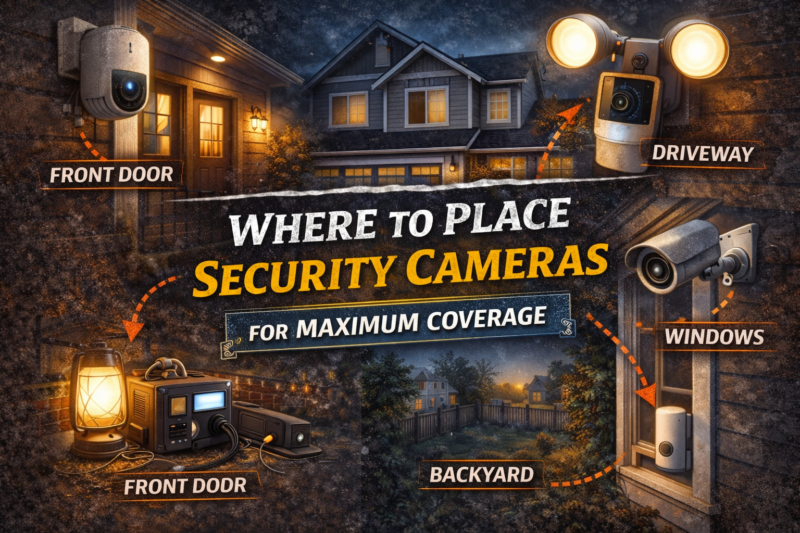
Where to Place Security Cameras for Maximum Coverage
TLDR
- Prioritize entry points: front door, back door, first-floor windows, and garage access
- Mount outdoor cameras 8 to 10 feet high and angle them to avoid glare and blind spots
- Use overlapping fields of view to eliminate coverage gaps
- Place indoor cameras in high-traffic common areas, not private spaces
- Combine cameras with lighting and alarm sensors for layered, reliable protection
Buying good security cameras is only half the equation.
Where you place them determines whether they actually help you or simply give you a false sense of coverage. I have seen setups with expensive cameras pointed at empty walls and cheap ones positioned perfectly that captured everything that mattered.
Camera placement is strategy. When done right, even a modest system can deliver excellent visibility and deterrence.
Let’s walk through how to position cameras for real-world effectiveness.
Start With Entry Points
If you are unsure where to begin, focus on doors.
The majority of residential burglaries involve unlawful entry through a door or ground-floor window. That makes exterior entry points your highest priority.
Your front door should always be covered. A doorbell camera works well here because it captures faces at a natural angle and records package deliveries.
Do not ignore the back door. Many intruders prefer less visible entry areas, especially if fencing or landscaping provides privacy.
Side doors, patio doors, and basement entrances also deserve attention. Cover every door that leads directly into your home.
First-Floor Windows Matter More Than You Think
Ground-level windows are vulnerable access points.
You do not necessarily need a dedicated camera for each window. Instead, position cameras to cover clusters of windows or long exterior walls where multiple windows are located.
If a window faces a secluded yard or alley, it becomes a higher priority. Visibility from the street naturally reduces risk, but secluded areas benefit from camera coverage.
Strategic angles often allow a single camera to monitor several windows at once.
The Garage and Driveway
Garages are common targets, especially if they provide interior access to the home.
Place a camera facing the driveway to capture vehicles approaching or parking. This is particularly useful for documenting license plates and delivery activity.
If your garage has a separate exterior door, treat it like any other entry point and ensure it is covered.
Inside the garage, a camera can monitor stored valuables such as tools or bikes. Just make sure it does not point directly at bright overhead lights, which can create glare.
Mount Cameras at the Right Height
Height plays a major role in coverage and image quality.
Outdoor cameras are typically mounted between 8 and 10 feet above ground. This placement makes them harder to tamper with while still capturing usable facial detail.
Mounting too high reduces identification value. Mounting too low makes the device vulnerable.
Angle the camera slightly downward and avoid pointing directly into the sun. Backlighting can wash out important details during certain times of day.
It may take small adjustments to get it right, but the difference is noticeable.
Avoid Blind Spots With Overlapping Coverage
One common mistake is treating cameras like isolated devices.
For maximum coverage, create slight overlap between adjacent cameras. If one device fails or misses an angle, another may still capture the activity.
Overlapping coverage is especially useful along long driveways, fences, or large yards. Think of it as building visual redundancy.
You do not need perfect 360-degree coverage, but you do want to eliminate obvious blind zones near entrances.
Use Lighting to Support Your Cameras
Cameras rely on available light to produce clear images, even when equipped with night vision.
Position cameras near exterior lighting whenever possible. Motion-activated floodlights dramatically improve nighttime video quality.
Infrared night vision works well in darkness, but it produces monochrome footage. Supplemental lighting can help capture color details and improve identification.
When I adjusted one camera to work alongside a motion light instead of against it, the improvement in clarity was immediate.
Lighting and cameras work best together.
Interior Camera Placement: Focus on Traffic Flow
Inside your home, place cameras in common areas rather than private spaces.
Living rooms, main hallways, and areas near primary entrances are ideal. These are high-traffic zones where someone moving through the house is likely to pass.
Avoid placing cameras in bathrooms or bedrooms. Privacy considerations are important, even in your own home.
Position indoor cameras in corners to maximize field of view. A diagonal angle often captures more area than a straight-on placement.
Watch Staircases and Transition Points
Staircases and hallway intersections act as funnels.
If someone enters the home, they often must pass through these transition points to access other rooms. A camera positioned to monitor a stairwell or central hallway can capture movement between floors.
This approach reduces the need for multiple cameras in individual rooms.
By focusing on movement paths instead of square footage, you increase coverage efficiency.
Consider Camera Field of View
Not all cameras see the same amount of space.
Field of view is measured in degrees. A wider angle captures more area but may reduce detail at distance. A narrower angle provides more focused detail but covers less ground.
Choose wide-angle cameras for open areas like yards or large living rooms. Use narrower angles for focused zones like doorways.
Positioning should match the camera’s capabilities. Do not expect a wide-angle lens to capture readable license plates from across the street.
Protect the Cameras Themselves
Placement should also consider physical security.
Avoid mounting cameras within easy reach. Use secure mounting hardware and place wiring out of sight when possible.
If you are using wireless cameras, ensure the Wi-Fi signal is strong at the mounting location. Weak signals can cause delayed notifications or missed recordings.
Before finalizing placement, test live video feeds to confirm consistent connectivity.
A camera that disconnects frequently does not provide maximum coverage.
Respect Privacy and Legal Boundaries
Camera placement must respect local privacy laws.
Generally, you can record areas on your property, but you should avoid pointing cameras directly into neighboring homes or private spaces.
Public-facing areas such as sidewalks or streets are typically visible from your property, but laws vary by location.
Being intentional about angles protects both your neighbors’ privacy and your own peace of mind.
Do Not Forget About Signage
Even when budget is limited, visible cameras and signage can serve as deterrents.
When cameras are clearly visible near entry points, they signal active monitoring. Deterrence reduces risk before footage is ever needed.
Placement near eye level at entry doors reinforces that visibility, even if the main recording device is mounted higher.
Deterrence and documentation go hand in hand.
Test Before You Finalize
Once cameras are installed, test them in real-world conditions.
Walk through your property during the day and at night. Check how motion detection responds. Review recorded footage for clarity and blind spots.
Small adjustments in angle or height can significantly improve coverage.
This testing phase is often overlooked, but it is where maximum coverage is truly achieved.
Layer Cameras With Other Security Measures
Cameras are powerful tools, but they are not standalone solutions.
Combine them with door sensors, motion detectors, reinforced locks, and proper lighting. Cameras document and deter, but alarms create immediate audible alerts.
Layering these elements strengthens your overall security posture without requiring excessive equipment.
Maximum coverage is not about quantity. It is about coordination.
Conclusion
Placing security cameras effectively is about prioritizing entry points, understanding movement patterns, and eliminating blind spots.
Start with doors and first-floor windows. Cover your driveway and garage. Mount cameras at the proper height, angle them carefully, and support them with lighting.
Inside, focus on common areas and transition points rather than private rooms. Test everything before you consider the job finished.
When you think strategically, you do not need dozens of cameras to feel protected. You need thoughtful placement that aligns with how people actually move around your property.
Security works best when it is layered, intentional, and practical. With the right placement, your cameras become a reliable part of that system rather than decorative tech on your walls.