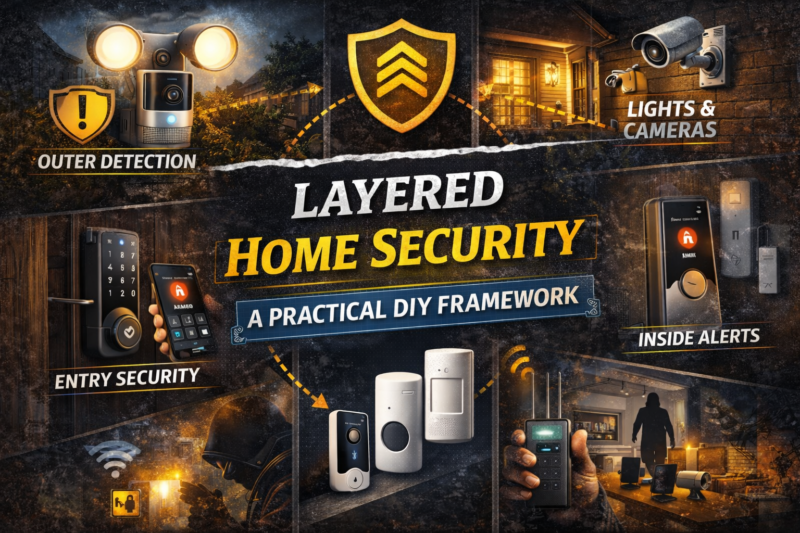
Layered Home Security: A Practical DIY Framework
TLDR
- Layered home security combines physical reinforcement, visibility, detection, and smart habits
- Most residential burglaries involve forced entry or unlawful entry through accessible points
- Reinforcing doors and securing windows are foundational first layers
- Lighting, cameras, and alarm systems increase detection and deterrence
- Consistent use, maintenance, and digital security complete an effective DIY framework
When people hear “layered security,” they often picture something complicated and expensive. In reality, it’s the opposite.
Layered home security is about stacking simple, practical protections so that no single weakness leaves your home exposed. Instead of relying on one device or one habit, you create overlapping barriers that reduce opportunity and increase effort for anyone attempting unauthorized entry.
You do not need a full renovation. You need structure. Let’s break that down into a clear, DIY home security framework you can actually implement.
Understanding How Residential Break-Ins Happen
Before building layers, it helps to understand patterns.
Crime data consistently shows that residential burglaries frequently involve forced entry through doors or unlawful entry through unlocked doors and windows. Daytime incidents are common because homes are often unoccupied during work hours. Ground-floor access points are used more frequently than upper levels.
This tells us something important. Most break-ins are not high-tech operations. They rely on access and speed. A layered system is designed to interrupt both.
Layer One: Harden the Physical Entry Points
The first layer is physical resistance. If entry takes longer and creates more noise, the likelihood of success decreases.
Start with doors. Exterior doors should be solid-core or metal-clad. Deadbolts should extend fully into the frame. Reinforcing the strike plate with longer screws that anchor into wall studs strengthens the door assembly significantly. Many law enforcement agencies recommend this upgrade because the frame often fails before the lock does.
Sliding glass doors benefit from secondary blocking devices in the track. These prevent lifting or forced sliding even if the latch is compromised.
Windows deserve equal attention. Ensure locks function properly and cannot be lifted from the outside. Ground-floor windows, especially those hidden from street view, may benefit from additional stops or sensors.
This layer is not glamorous. It is foundational.
Layer Two: Control Visibility and Lighting
Criminal behavior research consistently highlights the role of visibility and perceived risk.
Motion-activated exterior lighting increases exposure around entry points. When someone approaches a dark side yard and the area suddenly lights up, anonymity disappears. Lighting does not prevent every incident, but it changes the environment in your favor.
Landscaping also plays a role. Shrubs trimmed below window height and clear sightlines to doors support natural surveillance. Overgrown hedges near entry points can provide concealment.
One simple test I often suggest is walking around your home at night. Notice where shadows gather and where someone could stand unseen. Those are your lighting priorities.
Layer Three: Add Detection Through Alarms and Sensors
Once physical barriers are in place, detection becomes the next layer.
Door and window contact sensors alert you when access points are opened. Glass break sensors detect specific acoustic patterns associated with breaking glass. Motion detectors monitor interior movement when the system is armed.
Modern DIY alarm systems allow remote monitoring and push notifications without requiring long-term contracts. Professional monitoring is an option, but even self-monitored systems provide immediate awareness.
Consistency matters here. A system only works when it is armed. Automating arming schedules or using geofencing features can reduce user error.
Detection does not just notify you. It increases perceived risk for an intruder, especially when paired with audible alarms.
Layer Four: Use Cameras Strategically
Cameras are often the most visible layer, and visibility itself can influence behavior.
Placement is more important than quantity. Prioritize main entry points such as front doors, back doors, and garages. Ensure cameras are positioned at angles that capture faces rather than just the tops of heads. Adequate lighting improves image clarity at night.
Doorbell cameras add a valuable layer at the primary entry point. They record interactions and provide live communication. Exterior cameras covering driveways and side yards expand awareness beyond the threshold.
It is important to secure camera accounts with strong, unique passwords and enable two-factor authentication when available. Consumer protection and cybersecurity agencies consistently recommend these measures to reduce unauthorized access.
Cameras are not a substitute for reinforced doors. They are a complementary layer.
Layer Five: Secure the Garage
Garages are frequently overlooked in home security planning.
An attached garage often provides direct interior access. That interior door should be secured with a deadbolt just like any other exterior door. Garage door openers should use rolling code technology, which is standard in modern units and reduces code interception risks.
If you park vehicles outside, avoid leaving garage door remotes visible inside. Some homeowners choose to use keychain remotes instead of built-in vehicle controls to reduce risk if a vehicle is accessed.
Treat your garage as part of the security perimeter, not a storage afterthought.
Layer Six: Strengthen Digital Perimeter Security
Your home network is part of your layered defense.
Routers should use current encryption standards such as WPA3 when available, or at minimum WPA2 with a strong password. Default login credentials should always be changed. Firmware updates for routers, cameras, and smart devices address known vulnerabilities and should be applied regularly.
Government cybersecurity agencies routinely emphasize these steps because connected devices can become entry points if neglected.
If your alarm system and cameras depend on Wi-Fi, securing the network is not optional. It is essential.
Layer Seven: Build Smart Daily Habits
Technology works best when paired with behavior.
Lock doors and windows consistently, even during short absences. Retrieve packages promptly. Use light timers when traveling to simulate occupancy. Avoid broadcasting extended absences publicly in real time.
Burglars often look for easy, low-risk opportunities. Habits that reduce predictability and visible absence help reduce attractiveness.
This layer costs nothing. It requires awareness.
Layer Eight: Review and Maintain Your System
Security is not a one-time project.
Batteries in sensors and cameras need replacement. Firmware updates need installation. Strike plates can loosen over time. Motion lights may drift out of alignment.
A simple biannual review keeps the layers intact. Test alarms. Confirm notifications are working. Walk the perimeter.
I personally schedule these checks at the same time I replace HVAC filters. Pairing tasks makes it easier to remember and keeps everything functioning as intended.
How the Layers Work Together
No single layer is perfect. That is the point.
A reinforced door slows forced entry. Lighting increases visibility. An alarm triggers attention. Cameras document activity. Strong digital practices prevent remote compromise. Smart habits reduce opportunity.
Each layer adds friction. Each layer increases effort and risk for someone attempting entry. Most residential burglaries are opportunistic and time-sensitive. Increasing resistance and uncertainty shifts the equation.
Layered security is not about creating a fortress. It is about creating enough obstacles that your home is no longer the easy option.
Building a Layered System on a Budget
A common concern is cost. The good news is that layering does not require purchasing everything at once.
Start with physical reinforcement. It is affordable and high impact. Add motion lighting next. Then consider a basic DIY alarm system with door sensors. Cameras can follow as budget allows.
Because each layer stands on its own, you can build gradually. This approach also gives you time to learn your system and adjust placement based on real-world use.
Intentional planning prevents overspending and avoids unnecessary complexity.
Conclusion
Layered home security is not complicated theory. It is a practical framework rooted in how residential crime actually occurs.
Harden entry points. Increase visibility. Add detection. Secure your network. Maintain consistent habits. Review periodically.
When these layers work together, you reduce opportunity and increase resilience without locking yourself into expensive contracts or overwhelming installations.
Security works best when it is simple, layered, and intentional. Build one layer at a time, and you will end up with a system that feels manageable, affordable, and effective.
That is real-world home defense.