🤖Understanding Matter 1.5: The Standard for Smart Security Cameras

TLDR
- Matter 1.5 is the first version of the Matter smart home standard to officially support security cameras.
- It introduces standardized live video streaming, two-way audio, motion detection, privacy zones, and pan-tilt-zoom controls.
- Matter 1.5 aims to reduce ecosystem lock-in by helping cameras work across different smart home platforms.
- Video storage remains controlled by manufacturers and platforms, meaning some features can still vary between brands.
- Adoption is growing, but support depends on both camera manufacturers and smart home ecosystems implementing the new standard.
For years, smart security cameras have been one of the most frustrating parts of the residential technology world. You buy a camera, install the custom software, create a unique account, and everything works fine initially.
Then you decide to expand your property layout with another peripheral from a different brand, and suddenly things become incredibly complicated.
One camera works flawlessly with your primary command center, another requires a completely separate app to check its live status, and a third only supports a tiny, limited set of smart home integrations. This annoying fragmentation is exactly what the unified industry protocol was created to address.
Matter is an open-source interoperability standard developed through the collaborative efforts of the Connectivity Standards Alliance. Its overarching goal is beautifully straightforward: make smart devices work together more easily, completely regardless of the parent brand.
Since its initial industry debut, the protocol has expanded steadily, systematically adding support for new device categories and improving underlying wireless network reliability.
The official introduction of Matter 1.5 security cameras marks an important developmental milestone because it finally brings native integration to one of the most requested property defense components on the retail market.
📊 Evolutionary Paradigm: Pre-Standardization vs. Matter 1.5
Before diving into the precise engineering modifications, it helps to look at how this integration fundamentally alters the architectural landscape for smart hardware. The baseline shifts focus entirely on removing custom, closed software components in favor of a universal language.
Historically, blending distinct hardware brands required developers to build custom software bridges for every single platform ecosystem. This fractured methodology limited your product options and made long-term system maintenance a total nightmare.
By looking at how the Connectivity Standards Alliance outlines the specification, we can see how this unified update reshapes device communication.
📋 Architectural Integration Matrix
| Before Matter 1.5 Standard | With Matter 1.5 Standard |
| Camera integrations required custom, proprietary APIs | Standardized, universal camera communication profiles |
| Different smartphone applications needed for different brands | Greater cross-platform compatibility and control options |
| Limited data interoperability between sensors and lenses | Shared camera feature framework across platforms |
| Ecosystem-specific features created vendor lock-in | Unified device category definitions for all certified brands |
📹 What Camera Features Does Matter 1.5 Support?
The headline breakthrough of this new version is its comprehensive, native inclusion of imaging hardware.
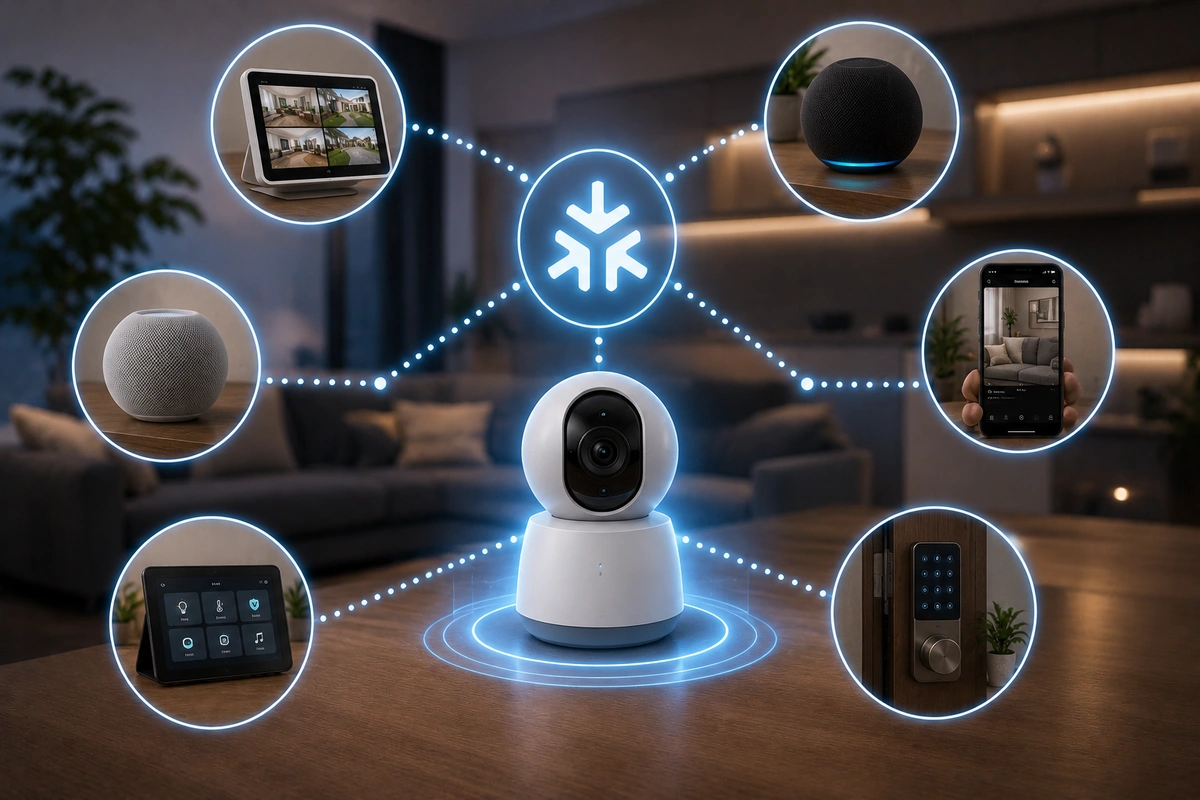
Rather than forcing manufacturers to abandon their unique branding or forcing platforms to build custom software bridges, the update establishes a common linguistic framework that compatible cameras and controllers use to speak to each other.
This incorporates several core security features that modern households rely on for daily perimeter monitoring.
The technical framework covers automated event notifications, spatial lens orientation adjustments, and real-time audio interaction tools.
This means a single certified device can push standardized activity telemetry directly into your preferred smart dashboard without requiring custom third-party integrations.
📋 Supported Core Camera Functions
- Real-Time Streaming: Low-latency live video and audio streaming feeds.
- Interactive Communication: Native support for two-way talk and audio pathing.
- Activity Telemetry: Standardized motion detection events to trigger broader system rules.
- Spatial Controls: Mechanical pan, tilt, and zoom configuration commands.
- Privacy Controls: Custom, user-defined localized privacy masking zones.
One critical detail worth noting is that the initial CSA Matter camera support framework focuses primarily on real-time communication and management rather than replacing every single localized feature offered by specialized brands.
For example, the underlying architecture of video clip archiving remains completely outside the core specification.
Whether your security footage is saved onto an internal MicroSD card, beamed to a local network video recorder, or pushed to an encrypted cloud subscription is still decided entirely by the manufacturer.
While this might sound like a structural limitation at first glance, it is actually a highly practical compromise.
Storage methodologies vary wildly across competitive brands, and forcing an identical data model too early would have severely tanked manufacturer adoption rates.
To weigh your options regarding video data management, you can review our balanced breakdown of local storage vs cloud storage for security cameras.
🔄 How Matter 1.5 Reduces Ecosystem Lock-In
One of the most appealing promises of the Matter smart home standard has always been its radical focus on consumer flexibility. Historically, purchasing a new outdoor or indoor lens meant committing your entire property to a single, specific software ecosystem.
If you invested heavily in a particular brand early on, switching your smart dashboard platform down the road could become an incredibly expensive and frustrating ordeal.
The new protocol iteration doesn’t completely eliminate these brand silos overnight, but it moves the residential defense market much closer to an open, consumer-first model.
Instead of forcing an engineering team to write unique, custom software patches for five different smart home assistants, the uniform framework allows a single device to broadcast its capabilities in a language that any certified system instantly understands.
💡 Expert Tip
Plan for Long-Term Expansion: When deploying a new system, looking for certified components ensures you won’t have to scrap perfectly good hardware if you change your phone ecosystem later. This flexibility is a massive asset when designing a home security system on a budget.
🎥 The Technology Behind Matter Camera Streaming
One of the most important technical decisions tucked into the new protocol version is the mandatory use of WebRTC (Web Real-Time Communication) for managing video and audio data paths.
While you might not recognize this technical name, WebRTC is an incredibly mature, battle-tested open-source framework that already powers a massive portion of real-time voice and video communication tools across the modern web.
For residential surveillance hardware, selecting this specific streaming methodology provides a dramatic improvement in day-to-day responsiveness.
It minimizes annoying buffer delays, matches audio feeds perfectly with live video, and ensures your interactive talk sessions run smoothly without weird audio cutouts.
📊 WebRTC Performance Advantages
| Technical Feature | Operational Benefit | Security Impact |
| Low-Latency Architecture | Faster live stream loading speeds when checking alerts | Reduces the delay when checking a live alarm trigger |
| Mandatory Peer-to-Peer Encryption | Protects media streams from interception | Prevents unauthorized snooping on your local network |
| Broad Multi-Platform Adoption | Simpler implementation across diverse smart devices | Ensures stable connections across different phone brands |
The real-world benefit for everyday users is incredibly straightforward: your live video feeds can be loaded instantly through a universal standard, rather than relying on clunky, slow, proprietary streaming servers.
To see how these real-time streaming updates impact a standard setup, look over our comprehensive guide to home security cameras explained types features and use cases.
🛡️ Security and Privacy Considerations
Whenever you install internet-connected lenses inside or outside your home, personal privacy becomes an absolute priority.
The Matter camera protocol was built from the ground up with strict security blueprints, requiring every single certified device to pass rigorous verification checks before joining a local network. Secure device authentication keys, fully encrypted communications, and protected onboarding steps are foundational mandates of the standard.
However, it is vital to understand exactly where the protocol’s built-in security boundaries begin and end.
While the standard does a fantastic job of protecting data as it moves between your local devices and your smart hub, your broader household privacy still depends heavily on a handful of external factors.
🔍 Read More
- Keep your system resilient by checking your hardware vendor’s ongoing software support and firmware deployment history.
- Set up strong multi-factor authentication steps to lock down your master system profiles against unauthorized remote access.
- Explore how to properly shield your smart appliances from potential online threats by reading our guide on how to secure your home wi-fi for security devices.
🔧 What Matter 1.5 Doesn’t Solve Yet
As exciting as this software milestone is for the industry, it is important to realize that the new standard isn’t a magical cure-all for every smart home headache.
Some consumers hear about a universal connection protocol and mistakenly assume that every single feature on their camera will suddenly work identically across every smart display and smartphone application on the market. In reality, the deployment landscape is a bit more nuanced.
Individual manufacturers still retain complete control over which advanced features they choose to expose to the open framework, and smart home platform applications still choose which specific capabilities they are ready to display.
As a result, two different certified cameras might use the exact same underlying communication protocol while still delivering slightly different user experiences depending on the primary smart hub you use to control them.
📋 Deconstructing Common Protocol Misconceptions
- The Myth: The new update means every security camera on the market will function identically.
- The Reality: Core tools like streaming and motion detection are standardized, but unique brand features remain distinct.
- The Myth: Adopting this standard means you can completely delete your manufacturer’s native smartphone app.
- The Reality: You will still need the original manufacturer app to manage advanced deep-dive settings and firmware updates.
- The Myth: The protocol automatically upgrades and fixes all older, legacy cameras overnight.
- The Reality: Legacy devices will only receive these features if the original manufacturer chooses to build and push an official retrofitted firmware update.
- The Myth: Every certified device will automatically default to local-only operation without the internet.
- The Reality: Cloud storage dependencies are still entirely up to the brand; you must check the original specs to see if your gear can operate reliably without an internet connection.
🚀 What This Means for DIY Home Security
For anyone passionate about configuring their own residential protection, this updated framework is easily one of the most transformative shifts the industry has seen in years.
The excitement doesn’t stem from the introduction of some wild, experimental sensor technology or a flashy artificial intelligence tool; rather, it matters because it directly attacks a massive compatibility problem that has plagued homeowners for over a decade.
A future where your perimeter cameras, window contact magnets, smart deadbolts, audible sirens, and automated lighting chains all communicate through a single, shared local language is a system that is infinitely easier to scale, cheaper to maintain, and far less frustrating to live with on a day-to-day basis. This unified evolution fits perfectly into a modern, layered residential security plan.
💡 Expert Tip
Build Around Modern Protocols: As you scale your system, choosing peripherals that embrace universal connectivity standards will keep your setup fast and reliable. For a closer look at how these technical underpinnings contrast with older wireless frameworks, read our detailed comparison of z-wave vs zigbee vs wi-fi.
🏁 Conclusion
The introduction of version 1.5 represents a massive, necessary leap forward for the smart surveillance market. For the first time in consumer electronics history, security cameras possess a formal, standardized home within the broader smart home conversation.
While widespread industry adoption will take some time and individual feature sets will continue to vary slightly between competing brands, the overall trajectory is incredibly encouraging for the consumer.
For homeowners, apartment renters, and DIY builders alike, the ultimate payoff of this technical standard is total product flexibility.
By steadily reducing our collective dependence on restrictive proprietary ecosystems, the industry is steadily marching toward a reality where your home defense devices work together naturally out of the box. That is phenomenal news for anyone who values practical, long-lasting property defense.