🔑 Smart Locks vs Traditional Locks: A Security Comparison

TLDR
- Traditional deadbolt locks remain highly reliable when properly installed and maintained.
- Smart locks add convenience through keyless entry, remote control, and activity tracking.
- Physical security strength depends more on lock quality and door reinforcement than lock type alone.
- Smart locks introduce digital risks, but reputable models include encryption and security safeguards.
- The best approach for most homes is combining a strong mechanical lock with smart features.
Locks are one of those household essentials that most people completely take for granted until they stop working smoothly or you find yourself locked out at the worst possible moment.
For many decades, traditional manual hardware has served as the absolute baseline standard for residential protection.
A solid heavy-duty deadbolt combined with a physical brass key was all it took to establish a secure perimeter.
Then, modern electronic smart systems burst onto the scene, bringing mobile applications, custom entry codes, and automated remote access into the residential mix.
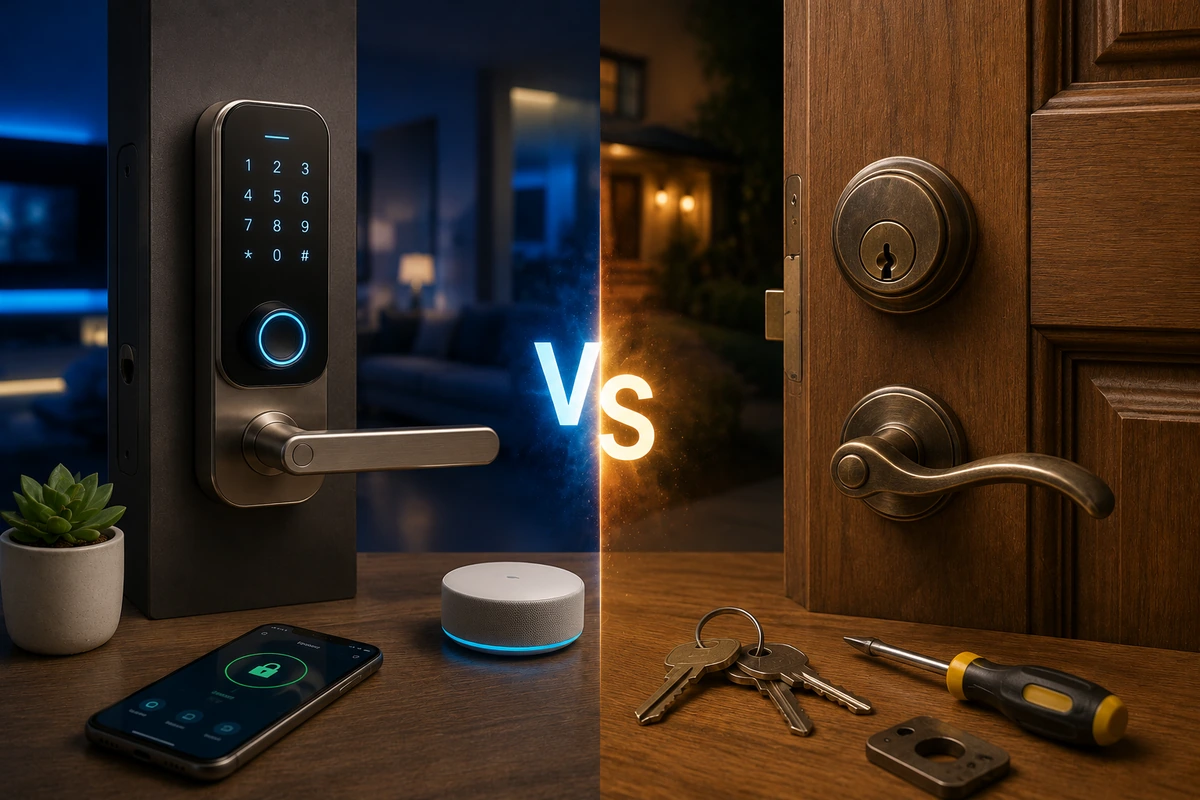
If you are currently trying to decide between these two paths, it is incredibly easy to feel pulled in opposite directions.
One option promises total mechanical simplicity and a century of proven operational reliability, while the alternate choice offers streamlined convenience and effortless control directly from your smartphone.
The reality is that both styles possess incredible defensive strengths, and both require you to accept distinct operational trade-offs.
Let’s break down the core details in a highly practical way so you can cut through the marketing noise and choose a configuration that makes sense for your property.
🛠️ How Traditional Mechanical Locks Work in Practice
Traditional locks operate as purely mechanical assemblies that rely entirely on physical force and precise geometry to protect your home.
The core of this design is the classic single-cylinder deadbolt, which drives a solid metal bolt deep into the receiving cavity of your structural door frame.
When you throw the bolt forward, this piece of hardened steel resists blunt impact forces, working around the clock to prevent the door from being easily kicked or pried open.
The internal mechanism operates on an intricate system of spring-loaded pins known as a pin-tumbler design.
When you insert the matching physical key, the ridges align the pins along a uniform shear line, allowing the cylinder to turn freely.
This standalone design operates completely independent of external infrastructure, meaning there are no complex wireless signals to manage, no local software code to update, and no internal batteries to monitor.
📊 Manual Lock Component Architecture
| Mechanical Component | Primary Security Function | Potential Vulnerability |
| Solid Steel Bolt | Resists blunt force and physical entry | Structural door frame splintering |
| Pin-Tumbler Cylinder | Authenticates the matching key blade | Lock bumping and professional picking |
| Physical Brass Key | Provides manual mechanical leverage | Unauthorized duplication or loss |
When you install high-quality manual hardware, you establish a consistent defensive foundation. To explore the broader fundamentals of setting up an independent residential perimeter, look over our master guide on diy home security where to start.
🏆 Where Traditional Locks Excel in Daily Defense
Total infrastructure reliability is the primary reason manual deadbolts remain the dominant choice for residential properties worldwide.
Because they function without a digital motherboard, a widespread power grid failure, a localized wireless router drop, or a dead internal battery will never impact your ability to secure your home.
When you examine a smart lock vs traditional lock setup, the mechanical option always wins on absolute simplicity and physical durability.
High-quality deadbolts are crafted to endure years of harsh weather exposure, freezing winter temperatures, and heavy daily usage with almost zero ongoing maintenance.
When you pair a high-end lock with a reinforced strike plate, you establish a formidable barrier that can dramatically slow down an opportunistic intruder.
💡 Core System Insights
Look Past the Lock Cylinder: Many property owners don’t realize that even the strongest deadbolt will fail if it’s attached to a weak frame. To prevent your premium manual hardware from being bypassed instantly, check out our tactical walkthrough on why why most homes are vulnerable despite having locks.
🛑 The Hidden Weaknesses of Traditional Hardware
Despite their impressive mechanical resilience, traditional entry systems possess clear operational limitations that modern lifestyles continue to expose.
The most glaring flaw centers around physical key management. Keys are surprisingly easy to lose, misplace, or share with temporary visitors who can duplicate them without your permission.
If an entry key goes missing, your only way to restore your property’s integrity is to physically rekey or completely replace the lock cylinders.
Furthermore, traditional mechanisms offer absolutely no way to monitor entry history; you cannot track who opened your door or confirm what time the event took place.
Basic low-cost deadbolts can also be vulnerable to manual manipulation tactics like lock bumping or lock picking if they lack integrated anti-pick pins.
🔍 Vulneribility Inspection Points
- Manual keys can be easily copied at automated hardware kiosks in less than a minute.
- Standard lock strike plates ship with short screws that fail quickly under physical impact.
- To discover the subtle procedural oversights that leave your entryways exposed, browse our full report detailing the most common security mistakes homeowners make.
⚡ How Modern Smart Locks Operate
Modern electronic entry systems blend traditional heavy-duty locking hardware with advanced digital control boards.
Instead of forcing you to carry a physical key everywhere you go, these systems allow you to retract the deadbolt using a backlit keypad, a smartphone app, or biometric fingerprint scanners.
This technological evolution sits at the center of the keyless vs key lock security upgrade movement.
The vast majority of top-tier electronic models still retain a hidden manual keyway on the exterior housing to serve as an emergency backup.
This safety feature guarantees you can always gain access to your home even if the electronic components experience a total system failure.
Internally, a motorized actuator moves the deadbolt into position once your digital credentials have been verified by the onboard processor.
💡 Core System Insights
Evaluate the Wireless Protocol: Connected entry systems communicate using different wireless technologies, including Bluetooth, Wi-Fi, Z-Wave, or Thread. To see how these communication signals impact your battery life and smart home integration, read our comparison on z-wave vs zigbee vs wi-fi.
🚀 The Massive Convenience of Going Keyless
Unmatched operational convenience is the biggest selling point when evaluating a smart lock vs deadbolt comparison.
You can walk up to your front door and gain entry without ever fumbling through your pockets or bags for a keyring, which is an absolute game-changer when your hands are full of groceries or gear.
Property owners can also generate unique, temporary entry codes for family members, cleaning services, or house guests.
These specialized access codes can be programmed to work only during specific hours of the day, ensuring you never have to hide a physical spare key under a vulnerable doormat or flowerpot.
📈 Daily Benefits of Going Keyless
- Custom Scheduling: Restrict service worker access codes to specific daytime hours.
- One-Touch Locking: Secure your entire perimeter with a single tap when leaving for work.
- Hands-Free Proximity: Program your door to unlock automatically as your phone approaches the porch.
- Smart Ecosystem Integration: Review the core capabilities of these connected platforms by looking over our guide on diy home security systems explained.
👁️ Access Control, Auditing, and Real-Time Tracking
Electronic locking systems introduce a crucial layer of situational awareness that mechanical deadbolts simply cannot match.
By utilizing a digital activity log, your lock tracks exactly when your door was accessed and identifies which specific code or user profile cleared the threshold.
This feature provides immense peace of mind for busy parents who want to verify that their children have arrived home safely from school.
Many connected models can also send instant push notifications directly to your phone the exact second an entry event occurs.
While these tracking features do not physically stop a forced entry attempt on their own, they give you an exceptional level of control over your home’s main entry points.
💡 Core System Insights
Layer Your Entryway Defenses: Access tracking works best when paired with visual confirmation tools. To see how to combine smart entry hardware with high-definition porch cameras, read our step-by-step guide on how to install a video doorbell step-by-step.
🔒 Digital Risks and Security Considerations for Smart Hardware
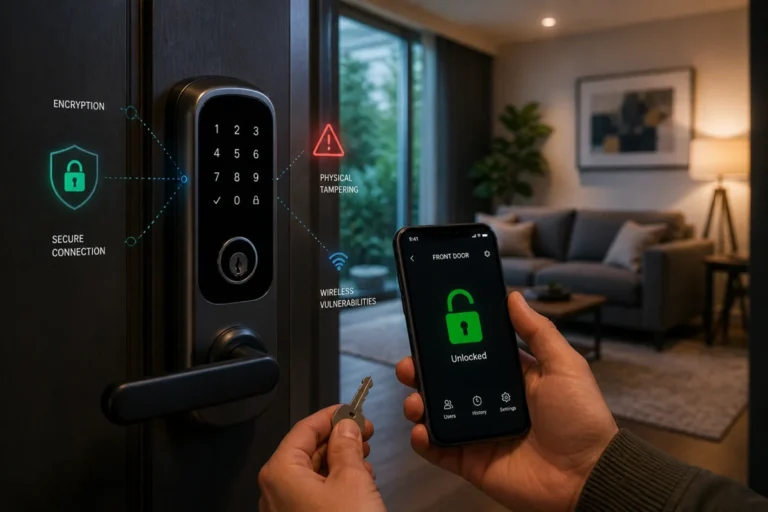
When you shift away from manual hardware, you move the smart lock vs key security debate into the realm of digital networks and cyber defense.
Many people ask: are smart locks safer than deadbolts? The truth is that smart models introduce digital entry points that traditional brass keys never have to contend with.
Reputable security brands minimize these digital risks by protecting wireless communications with advanced, military-grade encryption protocols.
However, if you use weak account passwords, neglect firmware updates, or leave your local internet router unprotected, you can create unexpected security vulnerabilities.
Fortunately, staying disciplined with your digital hygiene can completely neutralize these modern network threats.
🔐 Digital Hardening Checklist
- Enforce complex, unique passwords across every connected home account.
- Turn on mandatory two-factor authentication (2FA) inside your lock’s mobile application.
- Keep your system resilient against remote software threats by following our instructions on how to secure your home wi-fi for security-devices.
- Regularly check the manufacturer’s mobile app to ensure your hardware is running the latest security patch.
🔋 Power Management and Long-Term Reliability
Unlike completely mechanical deadbolts, electronic entry systems require a continuous power source to drive their internal motors.
Most models run on standard AA alkaline or lithium batteries, which deliver several months of reliable operation depending on how often the door is used.
Top-tier manufacturers build clear low-battery warnings directly into their software to alert you weeks before the cells run dry.
If you happen to ignore these urgent warnings and the batteries drain completely, you are still rarely left stranded outside.
Most modern smart locks include external metal terminals on the bottom of the housing, allowing you to press a standard 9-volt battery against the contacts to instantly power up the keypad and enter your code.
📊 Energy Consumption Management
| Battery Type | Expected Operational Lifespan | Cold Weather Performance | Recommendation Status |
| Standard Alkaline | 6 to 9 Months | Moderate voltage drops | Baseline standard |
| Lithium Batteries | 12+ Months | Exceptional output retention | Highly recommended |
| Rechargeable Packs | 4 to 6 Months | Poor capacity stability | Not recommended |
Managing power cells is a simple task that ensures your system stays completely dependable. To master your home’s power planning, check out our guide on managing batteries in a diy security system.
🏛️ Physical Door Strength Still Matters Most
An essential concept that routinely gets overlooked in the pros and cons of smart locks vs traditional analysis is that the lock cylinder is only one small part of a larger structural network.
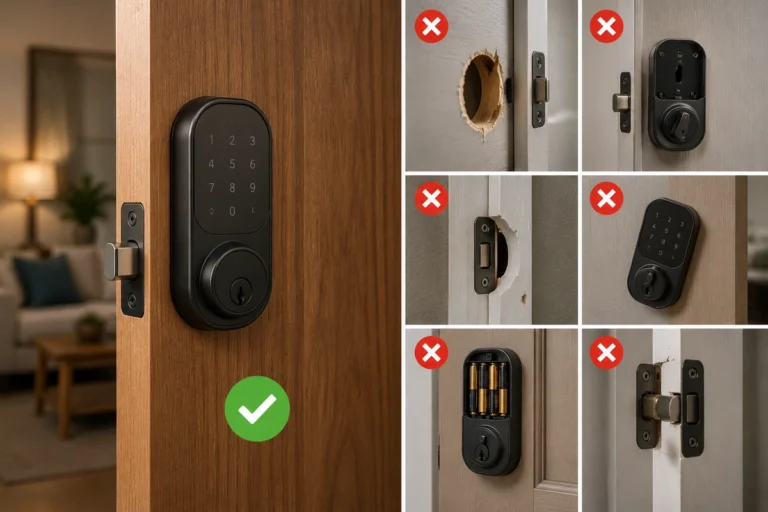
A premium smart lock or a high-end manual deadbolt will fail quickly if it is installed inside a flimsy door or an unreinforced wood frame.
If an attacker uses a heavy crowbar, they aren’t trying to pick your lock mechanism; they are trying to splinter the wood surrounding the strike plate.
True physical security depends far less on whether your lock uses a digital keypad or a traditional brass key, and far more on the reinforcement of the door jamb itself.
Using long steel screws to secure your strike plate deep into the underlying wall studs will do more to prevent forced entry than spending hundreds of dollars on a fancy lock brand.
💡 Core System Insights
Reinforce the Frame First: Upgrading the physical wood and metal components around your door frame is an incredibly cost-effective security upgrade. Learn how to harden your main entryway by reading our practical guide on door jamb reinforcement is it worth it.
💰 Upfront Costs vs Long-Term Value
Traditional mechanical deadbolts are incredibly budget-friendly.
You can pick up a rock-solid, Grade 1 manual deadbolt from a reputable manufacturer for a very modest upfront price, making it an excellent option for cost-conscious property owners.
Electronic options require a much higher initial investment because you are paying for motorized gears, biometric sensors, wireless radios, and ongoing software development.
While the initial price tag is higher, many busy families find the added convenience and tracking capabilities are well worth the investment.
📊 Initial Capital Expenditure Versus Value
- The Budget Approach: Focus your available funds on maximizing physical entry barriers. You can review this strategy in our blueprint on designing a home security system on a budget.
- The Connected Approach: Invest in high-end electronic hardware to gain access scheduling, remote control, and automated smart home routines.
❓ Which Lock Solution Wins the Security Debate?
When trying to figure out which lock is more secure, there isn’t a single option that fits every home perfectly.
Traditional deadbolts provide exceptional physical reliability and a long track record of proven defense.
Smart locks introduce incredible visibility, flexible access control, and keyless convenience, but they require you to stay on top of digital network safety.
For the vast majority of modern homes, the most effective approach is to blend these two concepts together.
Because top-tier smart locks are engineered around rugged, time-tested physical deadbolt cores, you don’t have to sacrifice physical strength to enjoy the benefits of keyless entry.
💡 Core System Insights
Evaluate Your Vulnerabilities: To see how an intruder analyzes your home’s entryways, check out our tactical overview on assessing your home like a burglar would.
🚪 Conclusion
Landing on the right choice between an electronic smart lock and a traditional deadbolt comes down to aligning your hardware with your daily habits and personal values.
If you prefer ultimate mechanical simplicity, low-maintenance hardware, and a set-it-and-forget-it approach, sticking with a high-quality manual deadbolt is a fantastic option.
If you love the idea of keyless convenience, need to manage access for family or service workers, and appreciate real-time activity tracking, an encrypted smart lock is a stellar upgrade.
At the end of the day, your front door security should make your life easier, not more complicated.
By picking a high-quality lock mechanism and taking the time to reinforce your physical door frame, you’ll create a welcoming, secure entrance that functions perfectly every single day.