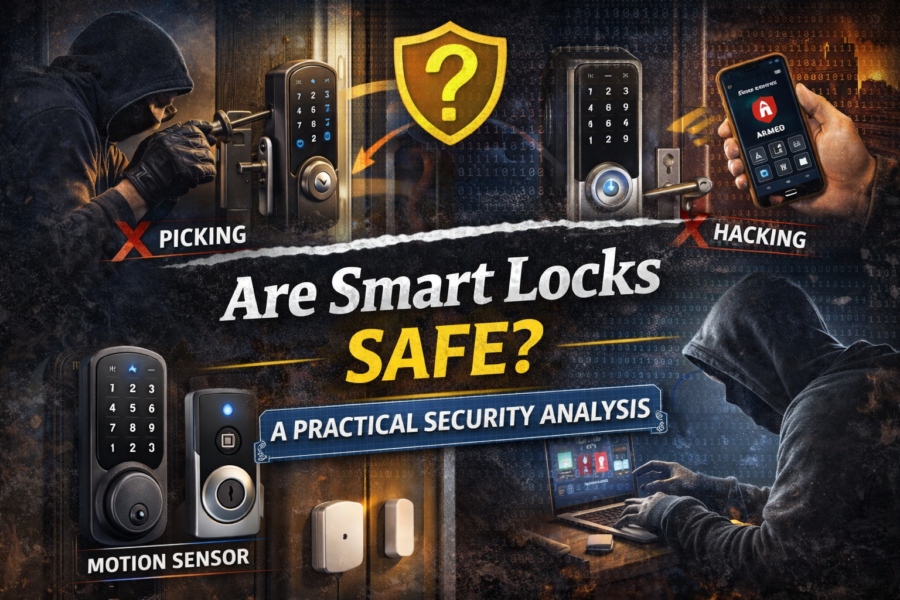
Are Smart Locks Safe? A Practical Security Analysis
TLDR
- Smart locks use encryption, authentication, and mechanical deadbolts to secure entry points
- Physical door strength and proper installation matter more than lock type alone
- Strong passwords, firmware updates, and two-factor authentication reduce digital risks
- Most smart locks include mechanical key overrides and battery backup alerts
- When installed correctly, smart locks can be as secure as traditional deadbolts while adding convenience and access control
Smart locks tend to spark strong opinions.
Some people see them as a clear upgrade over traditional keys. Others worry that adding connectivity to a front door somehow makes it easier to break into. The truth sits somewhere in the middle, and it’s more practical than dramatic.
If you’re considering a smart lock for your DIY home security, the real question is not whether they are “safe” in theory. It’s whether they are secure when properly installed, configured, and maintained. Let’s walk through that step by step.
How Smart Locks Actually Work
Most residential smart locks replace either the entire deadbolt or just the interior thumb turn mechanism.
Mechanically, many models still rely on a standard single-cylinder deadbolt design. When locked, a metal bolt extends into the strike plate just like a traditional keyed deadbolt. The difference is in how that bolt is actuated.
Instead of turning a physical key alone, the bolt can be controlled by a keypad, smartphone app, Bluetooth connection, Z-Wave or Zigbee network, or Wi-Fi bridge. Internally, a motor drives the locking mechanism when authentication is successful.
From a purely mechanical standpoint, the security of the bolt and strike plate remains critical. A smart lock installed on a weak door frame is no stronger than the door itself.
Mechanical Strength Still Matters
One of the most overlooked points in smart lock debates is this: break-ins often target the door frame, not the lock cylinder.
Reinforcing the strike plate with longer screws that anchor into wall studs significantly increases resistance to forced entry. This applies equally to traditional and smart deadbolts.
Many smart locks are built to meet established residential lock standards for durability and strength. Those standards evaluate resistance to forced entry, drilling, and repeated use cycles.
If the door and frame are solid, and the lock meets recognized testing standards, the mechanical security is comparable to a conventional deadbolt.
Digital Security: Where the Real Questions Are
Unlike traditional locks, smart locks introduce digital communication. That’s where concerns usually focus.
Most modern smart locks use encrypted communication protocols to prevent unauthorized interception. Bluetooth connections, for example, typically use encryption standards designed to protect transmitted data. Z-Wave and Zigbee smart home protocols also incorporate encryption and authentication mechanisms.
Wi-Fi enabled locks rely on your home network security. That means your router’s encryption settings, password strength, and firmware updates play a role in overall safety.
The lock itself is only one piece of the digital chain.
Passwords, Apps, and Account Protection
If you use a smart lock app, your account credentials matter.
Strong, unique passwords and two-factor authentication reduce the risk of unauthorized account access. Many manufacturers now support multi-factor authentication as part of their account systems.
Failing to update default passwords or reusing credentials across services increases vulnerability. This is not unique to smart locks. It applies to any connected device.
In practical terms, if you already manage smart cameras or alarm systems responsibly, the same habits apply here.
What About Hacking?
The idea of someone remotely unlocking your door feels unsettling. It’s important to keep perspective.
Security researchers have demonstrated vulnerabilities in certain smart devices over the years, often due to outdated firmware or weak configuration. Manufacturers regularly release updates to address discovered issues.
This is why firmware updates matter. Keeping the lock’s software current reduces exposure to known vulnerabilities.
No consumer device is immune to flaws. The question is whether updates are supported and whether you apply them.
Keypads vs Physical Keys
Many smart locks include a keypad for PIN-based entry. This introduces another layer of access control.
Temporary codes can be created for guests, service providers, or renters and deleted when no longer needed. That reduces the risk associated with copying physical keys.
Some models still include a traditional key cylinder as a backup. Others are key-free and rely entirely on electronic entry plus battery backup.
Key override options provide redundancy in case of electronic malfunction.
Battery Life and Power Concerns
Smart locks are typically battery-powered.
Manufacturers design them to send low-battery alerts well before complete depletion. Many systems provide weeks of warning through app notifications and audible indicators.
If batteries fully drain, models with key overrides can still be unlocked manually. Some key-free models include external contact points for temporary power from a battery pack to allow entry.
From a practical standpoint, routine battery replacement is part of ownership, similar to maintaining smoke detectors.
Auto-Locking and Human Error
One advantage of smart locks is automation.
Auto-lock features can secure the door after a preset time. Remote locking allows you to check and secure the door from anywhere with internet access.
Human error plays a significant role in home security. Forgetting to lock a door is more common than lock failure. Smart locks can reduce that risk when configured properly.
I’ve personally found remote lock verification to be one of the most reassuring features. Not because I forget constantly, but because it removes doubt.
Are Smart Locks Safer Than Traditional Locks?
Safety is not binary.
A high-quality traditional deadbolt installed on a reinforced door is already a strong physical deterrent. A smart lock built to similar mechanical standards offers comparable resistance, with added convenience and access control.
The added digital layer introduces new responsibilities, but it also introduces new tools. Audit logs, temporary codes, and remote control can enhance security when used thoughtfully.
The real vulnerability often lies not in the lock technology itself, but in poor installation, weak passwords, or neglected updates.
Situations Where Smart Locks Make Sense
Smart locks are especially practical for:
- Homes with frequent guest access
- Short-term rentals
- Families with children who may forget keys
- Homeowners who want integrated smart home control
They allow controlled access without duplicating physical keys. Access can be revoked instantly without rekeying hardware.
For single-occupant homes with minimal key sharing, the convenience factor may matter more than advanced features.
Situations Where They May Not Be Ideal
In extremely remote areas with unreliable internet and no need for remote access, a traditional mechanical lock may be simpler.
In high-security environments requiring commercial-grade hardware and access control systems, consumer smart locks may not meet specific compliance requirements.
Matching the tool to the use case is important.
Integrating Smart Locks Into Layered Security
A smart lock should never be your only security measure.
Pair it with reinforced door frames, exterior lighting, cameras, and an alarm system. If someone attempts forced entry, the alarm and cameras provide detection and documentation.
Layered security reduces reliance on any single device. The smart lock becomes one component within a broader framework.
Final Verdict
Are smart locks safe?
When built to recognized mechanical standards, installed correctly, connected to a secured network, and maintained with strong passwords and updates, they can provide security comparable to traditional deadbolts while adding meaningful convenience and control.
They are not magic. They are not inherently dangerous. They are tools.
If you approach them with the same practical mindset you apply to any DIY home security upgrade, they can fit comfortably into a simple, layered, intentional system.
Security is rarely about eliminating all risk. It’s about managing it intelligently. Smart locks, used properly, can absolutely be part of that strategy.
Blog
-
Best Budget Home Alarm Systems
Budget home alarm systems can provide solid protection without long-term contracts or expensive professional installation.
-
Best DIY Home Security Cameras for Apartments
Apartment security does not require a complicated system.
