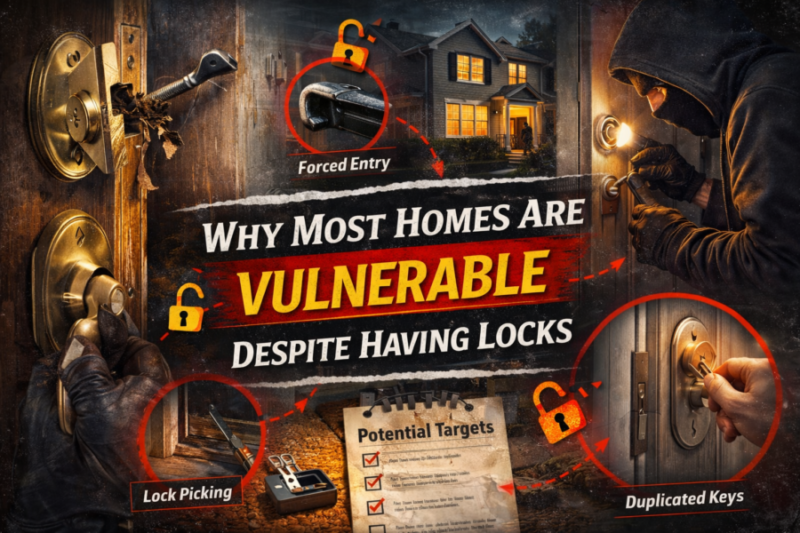
Why Most Homes Are Vulnerable Despite Having Locks
TLDR
- Most burglaries rely on simple access points like doors and windows, not advanced lock-picking
- Many homeowners rely on handle locks or weak door frames that fail under pressure
- Unsecured windows, garages, and sliding doors often bypass even good front-door locks
- Spare keys, outdated access codes, and poor digital security weaken physical protection
- Real security comes from layered reinforcement, not locks alone
It’s easy to assume that once you turn a key, your home is secure. The lock clicks, the door feels solid, and you move on with your day. That sense of finality is comforting.
But here’s the uncomfortable truth: a lock by itself is not a security system. It’s a single component. And in many homes, it’s the only one.
After years writing about DIY security setups and reviewing real-world cases, I’ve seen the same pattern again and again. Homes are rarely vulnerable because they lack locks. They’re vulnerable because those locks are misunderstood, poorly supported, or quietly bypassed.
Let’s break down why.
A Lock Is Only as Strong as the Door Around It
A high-quality deadbolt sounds impressive on the box. Solid metal, hardened core, anti-drill features. All good things.
But the bolt doesn’t anchor into concrete. It anchors into a strike plate, which is often secured with short screws driven into decorative door trim rather than structural framing. Under force, the wood splits long before the lock fails.
That means the weak point is not the lock cylinder. It’s the surrounding material.
Replacing short screws with longer structural screws and reinforcing the strike plate dramatically increases resistance. It’s a small hardware upgrade that changes the outcome of forced entry attempts. Yet most homeowners never think about it.
Handle Locks Are Not Security Locks
Many exterior doors have two locking points: the handle latch and a deadbolt above it. The latch lock is designed primarily for alignment and light privacy, not security.
When people leave home and only lock the handle, they are relying on a spring-loaded latch. These can be defeated with modest force or basic prying. The deadbolt exists for a reason.
Consistently locking the deadbolt is one of the simplest, highest-impact security habits available. It costs nothing and eliminates a major vulnerability.
Windows Are Frequently Overlooked
You can have the strongest front door on the block and still leave yourself exposed through a side window.
Data from crime victimization reports consistently shows that unlawful entry often occurs through windows or secondary doors. Rear and ground-level windows are especially vulnerable because they’re less visible from the street.
Many sliding windows and doors can be lifted out of their tracks if they lack secondary stops. Others have aging latches that don’t fully secure the frame.
Testing each window after locking it is eye-opening. If it shifts significantly, it needs reinforcement. Window pins, track blockers, or secondary locks are inexpensive and effective.
Garages Create a False Sense of Security
Garages feel internal, so people treat them differently. Interior garage doors are often left unlocked. Remote controls are left in vehicles parked outside overnight.
If someone gains access to the vehicle, the home is next. If the overhead door’s emergency release is accessible from outside, it can be disengaged with simple tools.
A locked garage interior door adds a layer many homes are missing. So does shielding the emergency release mechanism and removing visible remotes from parked cars.
The garage isn’t separate from the house. It is an entry point.
Spare Keys Undermine Good Locks
It doesn’t matter how advanced your deadbolt is if a working key sits under the doormat.
Spare keys hidden outdoors remain common, even though hiding spots are widely known. Under planters, fake rocks, above door frames. These locations are routinely checked.
Keypad locks or temporary access codes solve the convenience problem without permanent exposure. If access changes, a code can be removed instantly. A physical key cannot be recalled once copied.
Security depends on control. Spare keys often remove it.
Digital Weaknesses Affect Physical Safety
Modern locks increasingly connect to apps and Wi-Fi networks. That adds flexibility, but it also introduces digital risk.
Many connected devices ship with default credentials that users forget to change. Routers sometimes retain factory passwords or outdated encryption settings. If someone can access the network, they may interact with connected security devices.
Changing default passwords and updating firmware are simple steps that protect physical security indirectly. Digital access is now part of home access.
Locks alone do not address this layer.
Visibility and Concealment Matter
A locked door hidden behind dense shrubs in a dark corner is more vulnerable than a modest lock visible from the street.
Intruders prefer privacy. Concealment reduces interruption risk. If someone can work on a door unseen, time is on their side.
Lighting, trimmed landscaping, and clear sightlines raise perceived risk. Even visible cameras, whether actively monitored or not, introduce uncertainty.
Security is psychological as much as mechanical.
Routine Creates Predictability
Locks protect openings. They do not protect patterns.
Leaving at the same time every morning and returning at the same time every evening creates a visible routine. An empty driveway for several consecutive nights communicates absence to wannabe burglars.
When nobody is home, a locked door becomes a delayed barrier rather than an immediate one. The absence of activity reduces interruption risk.
Timers, staggered lighting, and bringing packages inside promptly help interrupt visible patterns. Occupancy perception matters.
Interior Doors Are Often Unsecured
In many homes, the door between the garage and living space lacks a deadbolt. Basement doors may have older hardware. Side entrances sometimes use handle locks alone.
Security should not stop at the front entry. Every exterior door should have a proper deadbolt and reinforced strike plate. Consistency closes gaps.
A chain is only as strong as its weakest link. In many houses, that weak link is simply a side door rarely used.
Maintenance Is Rarely Performed
Locks wear out. Screws loosen. Strike plates shift slightly over time.
Because these changes happen gradually, they go unnoticed. A door that once aligned perfectly may now require force to close, reducing full bolt engagement. A misaligned bolt does not seat deeply into the frame.
Periodic inspection solves this. Close the door slowly and observe the bolt entering the strike plate. It should seat fully without resistance. If not, adjustment is needed.
Small alignment issues become security issues over time.
Perception of Safety Replaces Actual Security
Neighborhood reputation influences behavior. If an area feels safe, people relax habits. Doors are left unlocked briefly. Windows remain cracked open.
Crime trends fluctuate, but opportunity-based entry remains consistent. A perceived safe environment does not eliminate risk. It sometimes increases vulnerability because residents are less vigilant.
Security works best when it is habitual rather than reactive.
Why Layered Security Changes Everything
A lock is a single barrier. Layered security adds reinforcement, detection, visibility, and habit.
Reinforcement strengthens the door frame. Detection alerts you to opening. Visibility discourages attempts. Habit ensures consistency.
Each layer compensates for potential failure in another. That’s the difference between relying on hardware and building a system.
In my own experience, the biggest improvements came not from replacing locks but from reinforcing frames, reviewing access points, and tightening routine habits. None of it was expensive. It was intentional and you can do it yourself.
Conclusion
Most homes are not vulnerable because they lack locks. They are vulnerable because locks are treated as complete solutions rather than components.
Weak frames, unsecured windows, exposed spare keys, predictable routines, and neglected maintenance quietly undermine good hardware. Add digital vulnerabilities, and the picture becomes clearer.
The good news is this: most of these weaknesses are fixable in an afternoon. Reinforce the door frame. Lock the deadbolt every time. Secure windows properly. Review access codes. Adjust lighting and visibility.
Security does not require complexity. It requires layers and consistency.
A lock starts the process. It just shouldn’t be the end of it.
Blog
-

Best Budget Home Alarm Systems
Budget home alarm systems can provide solid protection without long-term contracts or expensive professional installation.
-

Best DIY Home Security Cameras for Apartments
Apartment security does not require a complicated system.
-
Backup Power Solutions for Home Security Systems
Backup power ensures that protection does not disappear when the grid does.
