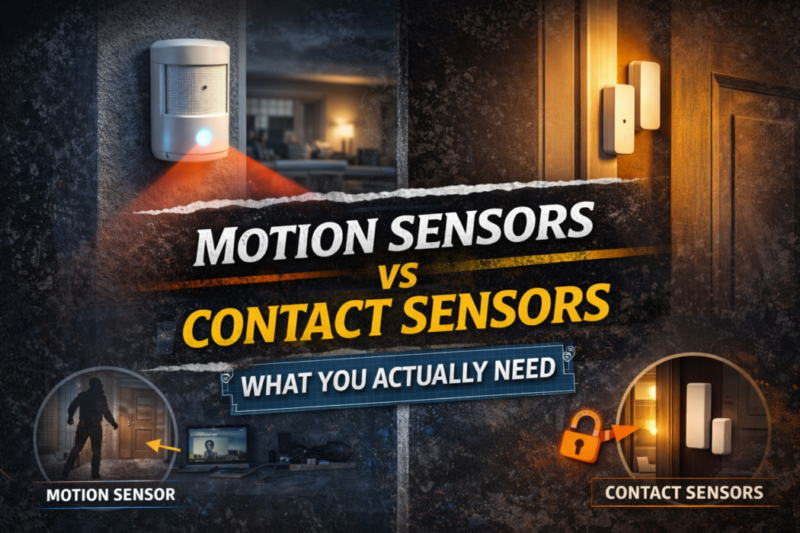
Motion Sensors vs Contact Sensors: What You Actually Need
TLDR
- Contact sensors detect when doors or windows open, making them ideal for perimeter protection
- Motion sensors detect movement inside a space and provide broader interior coverage
- Most motion sensors use passive infrared technology to sense body heat movement
- Contact sensors are precise and low-false-alert, while motion sensors cover larger areas with fewer devices
- A layered system typically benefits from using both, based on layout and lifestyle
When you start building a DIY alarm system, you usually face this question pretty quickly: do you need motion sensors, contact sensors, or both?
On paper, they seem similar. They both trigger alerts. They both connect to your alarm panel. They both promise protection.
In practice, they serve very different roles. Understanding how each works and where it performs best makes it much easier to build a system that fits your home instead of overcomplicating it.
Let’s break this down clearly and practically.
What Contact Sensors Actually Do
Contact sensors, sometimes called entry sensors, are designed to detect when a door or window opens.
They consist of two small components: a sensor and a magnet. One piece attaches to the frame, the other to the moving part of the door or window. When the two pieces separate beyond a certain distance, the circuit breaks and the system registers the opening.
That’s it. Simple, direct, and very precise.
Because they trigger only when the door or window physically opens, they are highly reliable and generate very few false alarms when installed correctly.
Where Contact Sensors Work Best
Contact sensors are perimeter devices.
They belong on exterior doors, accessible windows, garage entry doors, and sometimes on interior doors that separate a garage from the main home.
Their job is early detection. If someone opens a secured entry point while the system is armed, the alert happens immediately.
In my experience, if you’re starting from scratch, contact sensors are the first devices to prioritize. They create a clear boundary around your home.
Limitations of Contact Sensors
Contact sensors do not detect movement inside a room. If a window is broken but not opened, a basic contact sensor will not trigger. That is why some systems add glass break detectors as an additional layer.
They also require one sensor per door or window. In homes with many accessible windows, the number of devices can add up.
Still, for direct entry detection, they are hard to beat.
What Motion Sensors Actually Do
Motion sensors detect movement within a defined area.
Most residential motion sensors use passive infrared technology. These sensors detect changes in infrared energy, typically caused by body heat moving across the detection field.
When a warm object, such as a person, moves within range, the sensor detects the shift in infrared pattern and triggers the system.
Unlike contact sensors, motion sensors do not rely on doors or windows opening. They monitor space rather than entry points.
Where Motion Sensors Work Best
Motion sensors are interior devices.
They are typically installed in living rooms, hallways, stairwells, or other high-traffic pathways. Their goal is to detect movement inside the home after someone has entered.
They are particularly useful in homes with multiple windows or complex layouts where installing a contact sensor on every opening may not be practical.
In smaller apartments, one well-placed motion sensor can cover a large portion of the living area.
Pet Immunity and False Alarms
Modern motion sensors often include pet immunity features. These are designed to ignore small animals below a certain weight threshold.
Pet immunity works by adjusting sensitivity and analyzing movement patterns. It is not foolproof. Very active pets or animals climbing furniture can still trigger alerts if they enter the detection zone.
Proper placement is critical. Avoid pointing motion sensors at stairs where pets move vertically, or at windows with direct sunlight that can create thermal shifts.
Contact sensors, by contrast, are rarely affected by pets. They only care whether something opens.
Coverage Strategy: Perimeter vs Interior
This is where the real decision happens.
Contact sensors protect the perimeter. They tell you when someone crosses the boundary.
Motion sensors protect the interior. They tell you when someone moves within the protected space.
Security professionals often describe this as layered detection. If someone bypasses a perimeter device, the interior layer provides a second opportunity to trigger an alert.
If you must choose only one type due to budget constraints, perimeter protection is generally prioritized. Detecting entry at the point of access provides earlier awareness.
That said, a small number of interior motion sensors adds valuable redundancy.
Installation and Maintenance Differences
Both sensor types are typically battery-powered in DIY systems.
Contact sensors are compact and mount directly on frames. Installation takes minutes and usually involves adhesive backing or small screws.
Motion sensors require more thoughtful positioning. They should be mounted at recommended heights, often around seven to eight feet, angled slightly downward to cover walking paths.
Batteries in both types generally last months to years depending on usage and manufacturer design. Most systems provide low-battery alerts.
When You Might Not Need Motion Sensors
There are situations where motion sensors may not be necessary.
If you live in a small apartment with a single entry door and limited accessible windows, well-placed contact sensors may provide sufficient protection.
If you are frequently home and only arm your system in away mode, motion sensors may remain inactive during daily use.
However, if you want overnight protection while sleeping, interior motion sensors placed outside bedroom areas can provide added confidence.
When You Might Not Need Contact Sensors on Every Window
Not every window carries the same risk.
Upper-floor windows that are not accessible by balcony or roof are generally lower priority. Ground-level windows hidden from street view deserve more attention.
If budget is tight, focus on doors and easily accessible windows first. Motion sensors can then supplement broader coverage.
Security is not about perfection. It is about reducing opportunity strategically.
Integrating Both Into a Practical DIY Framework
In most homes, the strongest approach combines both.
Install contact sensors on exterior doors and accessible windows. Place motion sensors in central areas that someone would likely cross if entering.
This creates overlapping detection zones. If a door is forced open, the contact sensor triggers. If someone manages to enter through an unmonitored opening, the motion sensor may still detect movement.
You do not need a sensor on every square foot. You need thoughtful placement.
Real-World Example: A Balanced Setup
In a typical three-bedroom home, a practical setup might include contact sensors on the front door, back door, garage entry door, and ground-floor windows.
Then add one motion sensor covering the main living room and another covering the hallway connecting bedrooms.
That configuration covers perimeter entry and interior movement without overwhelming the system.
In my own testing setups, I’ve found that fewer, well-placed devices outperform a scattered approach. Coverage zones matter more than device count.
The Bottom Line
Motion sensors and contact sensors are not competitors. They serve different purposes.
Contact sensors detect entry at the boundary. Motion sensors detect presence inside.
If you are building a system from scratch, start with perimeter protection. Then add interior motion detection to create depth.
Security works best when it is layered and intentional. You do not need every possible sensor. You need the right sensors in the right places, aligned with how your home is actually used.
Once you understand the role each device plays, the decision becomes much simpler.
Blog
-

Best Budget Home Alarm Systems
Budget home alarm systems can provide solid protection without long-term contracts or expensive professional installation.
-
Best DIY Home Security Cameras for Apartments
Apartment security does not require a complicated system.
