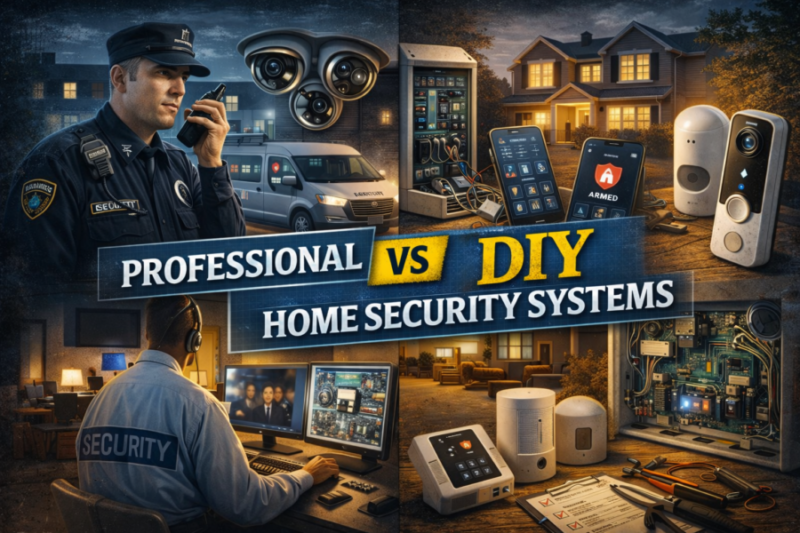
Professional vs DIY Home Security Systems
Deciding between a professional and a DIY home security system is one of the first crossroads you’ll hit when you start thinking seriously about protecting your home. Both paths get you closer to peace of mind, but they involve very different experiences, responsibilities, and trade-offs.
This article breaks down the key differences, the real-world pros and cons of each, and how to choose based on your needs, budget, and comfort level with technology.
You don’t need to feel confused or overwhelmed here. I’ve walked this road myself, installed systems on both sides of the line, and learned plenty along the way.
I’ll share that experience where it helps, but most of what follows is grounded in what trustworthy testing and industry standards say about how these systems perform long-term.
What Makes a “Professional” System
Installation and Monitoring
Professional systems are usually installed by trained technicians. They typically include professional monitoring – a 24/7 service where trained staff respond to alerts from your system, verify whether an alarm is legitimate, and contact emergency responders on your behalf if needed.
In many cases, the installation is handled for you end-to-end, including cable runs, sensor placement, and configuration. If you want a turnkey solution where someone else takes care of every setup detail, this is often the path people choose.
Contracts and Service Agreements
A hallmark of many professionally monitored systems is a contract – often one, two, or three years. In exchange for professional monitoring, extended warranties, and service support, you agree to ongoing payments that continue for the life of the contract.
Some providers will let you add features over time, like home automation devices or environmental sensors (for smoke, CO, flood detection), but the pricing structure usually bundles monitoring and service in a monthly fee.
What Makes a “DIY” System
Installation You Handle Yourself
DIY systems are exactly what the name implies: you buy the equipment, install it yourself, and manage it yourself. Today’s DIY devices are designed to be user friendly: peel and stick sensors, magnetic mounts for cameras, step-by-step app guidance, and no special tools required.
That simplicity is one of the biggest reasons homeowners and renters choose this route. You control placement, timing, and upgrades without waiting for appointments or scheduling installers.
Flexible Monitoring Options
With many DIY systems, professional monitoring is optional. You can choose to self-monitor – meaning alerts go to your phone, and you decide how to respond – or subscribe to a monitoring service for an added fee. That flexibility is a key difference from traditional pro systems, where monitoring is usually built in.
You also choose whether you want cloud recording, local storage (like on an SD card or local hub), or both. This lets you tailor your privacy and backup strategy.
Head-to-Head Comparison
Here’s how the two approaches stack up across the most important factors people care about.
Cost
DIY systems typically have a lower upfront cost because you’re buying the hardware and avoiding installation fees. There’s often no contract, and monthly costs (if you choose monitoring or cloud storage) can be very modest.
Professional systems usually have higher initial and ongoing costs. There’s often a one-time installation fee plus a mandatory monthly monitoring charge. Over a few years, those payments add up.
For people who want lowest cost over time, DIY often wins – especially if you’re comfortable self-monitoring and handling basic troubleshooting.
Ease of Setup
If you want someone else to handle the setup, professional systems shine. Technicians will place sensors and cameras based on best practices, run wires neatly if needed, and ensure everything is configured correctly.
DIY systems, by contrast, put you in the driver’s seat. Most people find installation straightforward, but it does take time and some patience if you’ve never done it before. There’s no installer to call if you make a placement mistake – you adjust it yourself.
Monitoring and Response
Professional monitoring adds a layer of response you can’t replicate at home: trained staff who evaluate alarms and call emergency services if necessary. For certain people – elderly homeowners, frequent travelers, or people with high-risk concerns – that professional response can be invaluable.
DIY self-monitoring puts responsibility on you. You receive alerts on your phone and decide what to do. That works well for many households, but it requires that you actually see and act on alerts quickly.
Customization and Control
DIY systems generally offer more flexibility. Want to place sensors where you choose? Want to pair cameras from different brands? Want to integrate devices with your smart home platform? DIY lets you mix and match to a greater extent.
Keep in mind that most DIY devices rely on your home Wi-Fi network. Securing your network is critical: change default passwords, use strong encryption like WPA3, and keep firmware updated. Following official guidance from the U.S. Cybersecurity and Infrastructure Security Agency can help you reduce risks and protect your connected devices.
Professional systems can be more restrictive, often requiring proprietary devices or only supporting specific brands or add-ons. That said, many providers do offer some level of smart home integration today.
Reliability and Support
Professional systems often include service and support as part of the contract. If a sensor fails or a camera stops communicating, you call the provider and they troubleshoot it with you. That support can be reassuring.
DIY systems depend on manufacturer support and forums. Many brands offer excellent help documentation and responsive support teams, but you are ultimately responsible for diagnosing and resolving issues.
Real-World Pros and Cons
Here’s how these differences play out in everyday use.
When Professional Makes Sense
- If you want guaranteed response from a monitoring center.
- If you don’t want to deal with installation or tech setup.
- If you value service agreements and on-site support.
- If you travel frequently or have pets or children at home often and want a live backup to your responses.
I’ve seen friends choose professional monitoring because they travel internationally and want someone to act if an alarm goes off while they’re asleep in another time zone. In that situation, the professional service is a safety net they’re willing to pay for.
When DIY Makes Sense
- If you want lower costs and no long-term contract.
- If you like customizing and upgrading your own gear.
- If you’re comfortable responding to alerts yourself.
- If you’re focused on key areas first (front door, ground-level windows, garage).
DIY systems are especially appealing to renters or owners of modest homes who want excellent protection without paying monthly fees they feel they don’t need.
Blended Approaches: Best of Both Worlds?
You don’t necessarily have to pick exclusively one or the other. Many people choose a hybrid path:
- Install a DIY system yourself for basics (door/window sensors, backyard cameras).
- Add cloud storage for recorded video.
- Subscribe to professional monitoring only during certain periods (like vacations).
That kind of blended strategy gives you control when you want it and support when you feel you need it. It’s one of the reasons the DIY market has expanded so much – manufacturers know people want flexibility, not lock-in.
Common Misconceptions
It’s worth addressing a few myths that come up in this debate.
Myth: Professional Systems Are Always More Reliable
Not necessarily. Modern DIY hardware, especially from top-rated brands, has proven reliability in real-world testing. Professional monitoring adds response, not necessarily more dependable sensors.
Myth: DIY Means Low Quality
Many people still imagine DIY systems as toy-like or flimsy. Today’s offerings include weather-proof outdoor cameras, advanced motion detection that reduces false alerts, and smartphone apps that rival pro-grade interfaces.
Quality varies by brand, of course, so reviews and independent performance tests matter. But DIY is no longer “budget junk” – it’s mainstream home technology.
Myth: Once Installed, a System Takes Care of Itself
Regardless of professional or DIY, any security system needs upkeep: checking batteries, updating firmware, ensuring cameras haven’t shifted, and reviewing alert settings as your household changes.
Professional providers may remind you or perform some maintenance, but routine care still matters.
How to Decide for Your Home
Here are a few questions to guide your choice:
Do you respond quickly to phone alerts? If yes, self-monitoring DIY might be fine. If not, professional monitoring adds a layer of response.
Do you travel often or live alone? Professional monitoring or cloud alerts might give extra reassurance.
Are you on a tight budget? DIY usually wins for lower costs and no contracts.
Do you want maximum control? DIY lets you choose devices and placement without service restrictions.
Answering these helps clarify which path aligns with your expectations.
My Experience With Both
When I first started securing my own home, I went the DIY route. A front-door camera and a few sensors gave me more confidence without a monthly bill. It took an afternoon to install and fine-tune, and I enjoyed the control of doing it myself.
Later, for a vacation house, I added optional professional monitoring because I knew I wouldn’t be nearby to respond to alerts. That combination gave me real peace of mind during long absences.
Neither path is inherently “right” for everyone. What matters most is matching the system to your lifestyle and habits.
Conclusion
Choosing between a professional and a DIY home security system isn’t about picking good or bad – it’s about picking what fits you. Professional systems give you dedicated monitoring and convenience. DIY systems give you cost-effective control and flexibility.
Across both worlds, your goals should stay the same: strong physical barriers, thoughtful device placement, and a system you will maintain over time.
Think about how you live, how you respond to alerts, and how much support you want. Start with the fundamentals, then build up from there at a pace and cost that feels comfortable. Security doesn’t have to be intimidating – it just has to work for you.
Blog
-
Best Budget Home Alarm Systems
Budget home alarm systems can provide solid protection without long-term contracts or expensive professional installation.
-
Best DIY Home Security Cameras for Apartments
Apartment security does not require a complicated system.
-
Backup Power Solutions for Home Security Systems
Backup power ensures that protection does not disappear when the grid does.
